Sisilia Frederika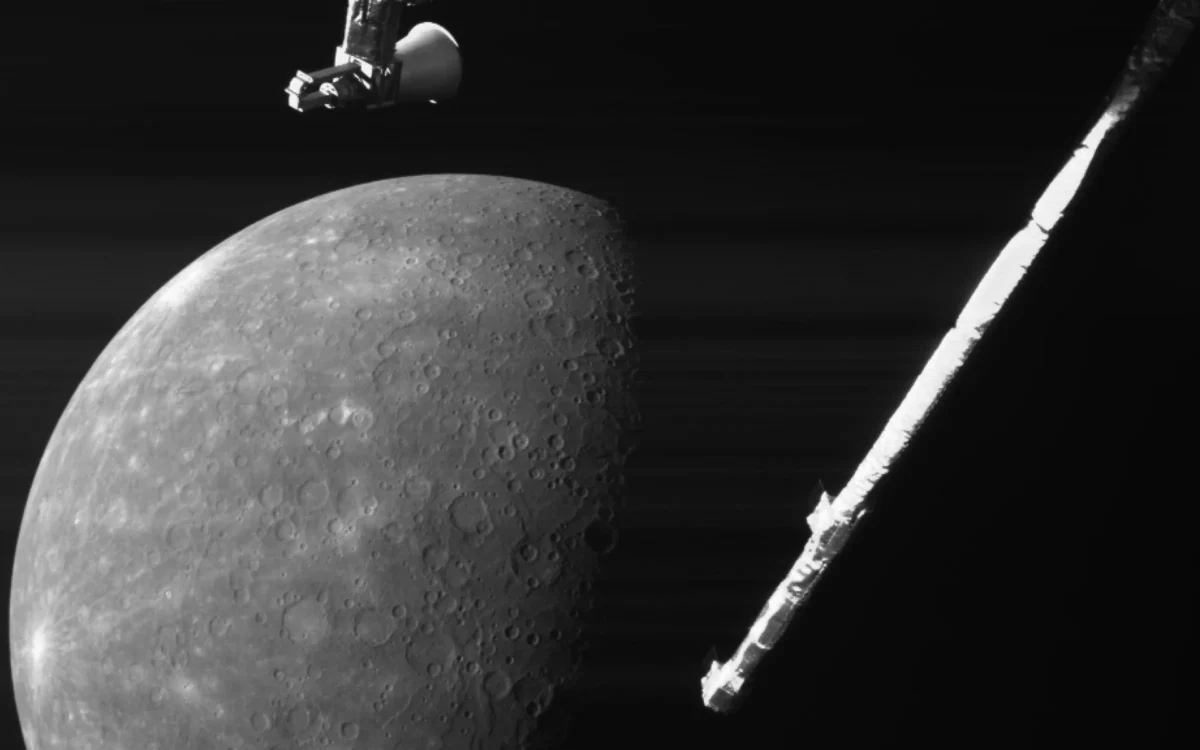
The joint European Space Agency (ESA) and Japan Aerospace Exploration Agency (JAXA) BepiColombo mission has achieved a significant scientific milestone during its fourth close encounter with Mercury. On September 4, 2024, the spacecraft executed a flyby that brought it within a mere 165 kilometers (102.5 miles) of the planet’s surface, providing an unprecedented opportunity to observe the interaction between solar radiation and the innermost planet of the Solar System. During this transit, the Solar Intensity X-ray and Particles Spectrometer (SIXS) instrument captured critical data showing how high-energy charged particles from a solar eruption bypassed Mercury’s magnetic shield to strike the planetary surface directly. This discovery, detailed in a new study published in Nature Astronomy by a team led by researchers from the University of Helsinki, offers vital insights into planetary defense mechanisms and the escalating risks posed by space weather to human infrastructure.
A Serendipitous Scientific Encounter
The timing of the fourth flyby proved to be exceptionally fortuitous for the international team of scientists monitoring the mission. As BepiColombo descended toward its closest approach, the Sun—currently in a period of heightened activity known as solar maximum—emitted a substantial burst of solar particles. This alignment allowed the SIXS instrument, developed by engineers and technicians at the University of Helsinki, to measure a "particle bombardment" in real-time.
Professor Emilia K. J. Kilpua, a specialist in space physics at the University of Helsinki and the study’s lead author, described the event as a unique window into the extreme environment of the inner Solar System. Because the spacecraft was significantly closer to Mercury than it will be during its final operational orbit, the sensors were able to detect particle fluxes that would typically be attenuated or redirected by the time they reached higher altitudes. The data revealed that during the eruption, high-energy particles penetrated the planet’s magnetosphere across a broad area, interacting with the crustal materials of Mercury.
This interaction triggers a process known as X-ray fluorescence. When high-energy solar particles or X-rays strike the atoms and molecules on the Mercury surface, they displace electrons, causing the atoms to emit secondary X-rays. By analyzing these emissions, scientists can not only study the intensity of the solar storm but also deduce the chemical composition of the surface features being bombarded.
Technical Capabilities of the SIXS Instrument
The Solar Intensity X-ray and Particles Spectrometer (SIXS) is a cornerstone of the BepiColombo payload. Its primary function is to provide a continuous monitor of the solar environment, measuring both the X-ray flux and the flow of protons and electrons from the Sun. This baseline data is essential for the Mercury Planetary Orbiter’s (MPO) other instruments, such as the Mercury Imaging X-ray Spectrometer (MIXS), which requires a precise understanding of the "solar input" to accurately map the planet’s elemental makeup.
The SIXS instrument comprises several sensors designed to detect a wide energy range of particles. During the September 2024 flyby, these sensors recorded a sharp spike in high-energy protons. The ability of SIXS to function under the intense thermal and radiation loads found at Mercury—where temperatures can exceed 430 degrees Celsius (800 degrees Fahrenheit)—is a testament to the engineering expertise at the University of Helsinki and their partner institutions.
Mercury’s Magnetosphere: A Fragile Shield
One of the most compelling aspects of the study is the comparison between Mercury’s magnetic field and that of Earth. Mercury is the only other inner rocky planet besides Earth to possess a global, intrinsic magnetic field. However, Mercury’s field is remarkably weak, possessing only about 1% of the strength of Earth’s magnetic field.
Because of this weakness, Mercury’s magnetosphere—the "bubble" of magnetic influence that protects a planet from the solar wind—is much smaller and more easily compressed. While Earth’s magnetosphere typically extends about 65,000 kilometers toward the Sun, Mercury’s magnetosphere is so compact that the planet’s surface occupies a significant portion of the protected volume.
The findings from BepiColombo show that during powerful solar events, Mercury’s magnetic defenses can be almost entirely overwhelmed. Co-author Rami Vainio, a professor of space physics at the University of Turku and co-Principal Investigator of SIXS, noted that observing these dynamics at Mercury provides a "worst-case scenario" laboratory for Earth. By understanding how destructive radiation penetrates Mercury’s small-scale environment, researchers can better model how Earth’s much larger magnetosphere might behave during a "superstorm" that compresses our magnetic defenses down to the level of our atmosphere or satellite orbits.
Chronology of the BepiColombo Mission
The BepiColombo mission has undergone a complex and arduous journey since its inception. Launched in October 2018 from the Guiana Space Centre in Kourou, French Guiana, the mission consists of two distinct science orbiters: the Mercury Planetary Orbiter (MPO), led by ESA, and the Mercury Magnetospheric Orbiter (Mio), led by JAXA.
To reach the innermost planet, the spacecraft could not fly in a straight line; doing so would require an impossible amount of fuel to counteract the Sun’s massive gravitational pull. Instead, the mission utilizes a series of nine planetary flybys to lose orbital energy:
- October 2018: Launch.
- April 2020: Earth flyby.
- October 2020 & August 2021: Two Venus flybys.
- October 2021 – September 2024: Six Mercury flybys.
The fourth Mercury flyby on September 4, 2024, was particularly critical as it served as a gravity assist to further refine the spacecraft’s trajectory. Earlier this month, the mission reached a pivotal milestone as the MPO and Mio orbiters began the process of separating from the Mercury Transfer Module (MTM), which has provided propulsion and power during the long cruise phase.
According to the current mission timeline, the two orbiters are scheduled to enter their final science orbits around Mercury in November 2025. By December 2025, they will separate from each other completely, with MPO moving into a lower, nadir-pointing orbit to study the surface and internal structure, while Mio enters a higher, elliptical orbit specifically designed to study the magnetosphere and its interaction with the solar wind.
Implications for Space Weather and Earth Resilience
The data collected by SIXS is already being integrated into the Center of Excellence in Space Resilience, a Finnish-led research initiative. This program focuses on the growing threat space weather poses to modern civilization. In an era where global communications, GPS navigation, and electrical power grids are increasingly reliant on orbital infrastructure, a major solar storm could have catastrophic economic consequences.
High-energy particles, like those detected hitting Mercury, can penetrate the shielding of satellites, causing "single-event upsets" in electronic components or permanent hardware failure. On Earth, these particles can trigger geomagnetic induced currents (GICs) in power lines, leading to widespread blackouts and the destruction of high-voltage transformers.
By studying Mercury, scientists are essentially observing a planet that "lives on the edge." The SIXS observations help calibrate models that predict how solar particles travel through the inner Solar System and how they interact with planetary magnetic fields. This improves the lead time and accuracy of space weather forecasts for Earth, allowing satellite operators and grid managers to take protective measures before a solar storm arrives.
Unlocking Mercury’s Mysteries
Beyond the study of space weather, the BepiColombo mission is tasked with solving long-standing enigmas regarding Mercury’s evolution. One such mystery involves the "hollows"—strange, bright, shallow depressions found on the floors and walls of some craters. Scientists suspect these features are formed by the loss of volatile materials from the crust, but the exact mechanism remains unknown. The observation of particle bombardment by SIXS suggests that solar radiation may play a more active role in "weathering" the surface and driving the formation of these features than previously thought.
Additionally, the mission seeks to confirm the nature of icy deposits found in permanently shadowed craters at Mercury’s poles. Despite being the closest planet to the Sun, the lack of an atmosphere means that areas in perpetual shadow remain cold enough to trap water ice for billions of years. BepiColombo’s comprehensive suite of instruments will provide the high-resolution data needed to understand the origin of this ice and what it reveals about the delivery of water to the inner planets.
Future Outlook
As BepiColombo prepares for its final orbital insertion, the scientific community anticipates a wealth of data that will redefine our understanding of the terrestrial planets. The success of the SIXS instrument during the fourth flyby has demonstrated that even during the transit phase, the mission is capable of delivering world-class science.
The collaboration between ESA and JAXA, supported by the specialized technical contributions from institutions like the University of Helsinki and the University of Turku, underscores the international nature of modern space exploration. As the Sun continues its peak activity cycle, the "particle bombardment" data from Mercury will serve as a vital component in the global effort to build a more space-resilient society, ensuring that the technology we depend on remains safe from the volatile whims of our host star.