Sisilia Frederika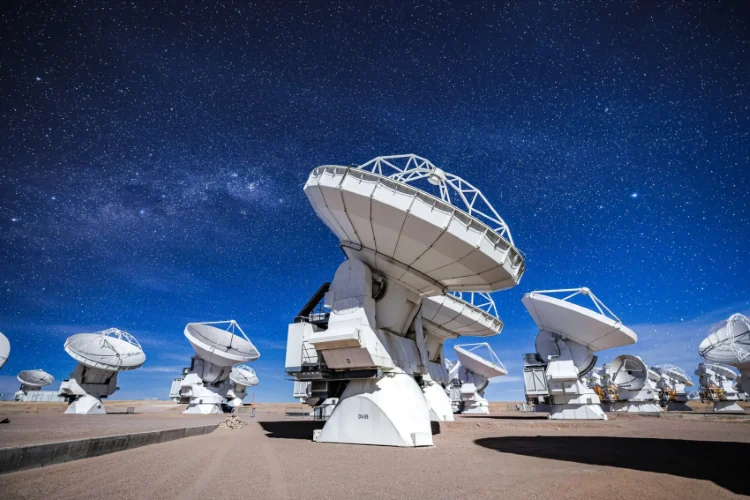
For decades, the search for extraterrestrial intelligence (SETI) has been defined by a narrow focus on a specific region of the electromagnetic spectrum, but a groundbreaking new study presented at the Royal Astronomical Society’s National Astronomy Meeting in Birmingham is challenging this long-standing convention. Louisa Mason, a PhD researcher at the University of Manchester, has introduced a paradigm shift in the hunt for technosignatures—measurable evidence of past or present technology used by extraterrestrial civilizations. By shifting the focus from traditional low-frequency radio waves to the largely unexplored millimeter and submillimeter bands, Mason has not only expanded the frequency range of the search but has also dramatically increased the volume of stars surveyed through advanced galactic modeling.
The search for life beyond Earth has historically concentrated on the "water hole," a radio frequency band residing between 1.42 and 1.66 gigahertz (GHz). This region is considered "quiet" in the radio spectrum, making it an ideal window for interstellar communication. The term originates from the fact that 1.42 GHz corresponds to the emission frequency of neutral hydrogen (H), while 1.66 GHz corresponds to the hydroxyl radical (OH). Because hydrogen and hydroxyl combine to form water (H2O), the basic building block of life as we know it, astronomers theorized that advanced civilizations might use these frequencies as a cosmic meeting place. However, despite over sixty years of monitoring this narrow band, humanity has yet to detect a verified, repeating signal from an alien source.
The Shift to High-Frequency Millimeter Waves
Mason’s research departs from the traditional decimeter and centimeter wave focus, moving instead toward the millimeter and submillimeter range, which spans 30 GHz to 3,000 GHz. Specifically, Mason utilized archived data from the Atacama Large Millimeter/submillimeter Array (ALMA) in Chile, focusing on "Band 3," which operates between 90.642 GHz and 93.151 GHz. This frequency range represents a significant departure from the 1.4 GHz water hole.
Millimeter waves offer several theoretical advantages for an advanced civilization. While they are more easily absorbed by Earth’s atmosphere—requiring high-altitude observatories like ALMA at 5,000 meters above sea level—they allow for much higher bandwidth. In the same way that 5G cellular networks utilize higher frequencies to transmit more data than 4G, an extraterrestrial civilization might utilize millimeter waves to beam vast amounts of information across the stars.
Mason’s study analyzed 1,327 specific observations. While no definitive technosignatures were found in this data set, the importance of the work lies in the methodology and the sheer scale of the census. By applying the Besançon Galactic Model (BGM) to the data, Mason was able to identify millions of stars that were inadvertently captured in the background of primary observations, effectively "piggybacking" on existing astronomical data to conduct a wide-area SETI survey.
From Thousands to Millions: The Power of Galactic Modeling
The primary innovation in Mason’s work involves the transition from using the Gaia star catalog to the Besançon Galactic Model. Gaia, a mission by the European Space Agency (ESA), has provided the most detailed 3D map of the Milky Way to date, cataloging nearly two billion stars. However, even Gaia has limitations when it comes to predicting the total number of stars within a specific telescope’s field of view at varying depths and sensitivities.
The Besançon Galactic Model is a sophisticated computer simulation of the Milky Way that incorporates stellar evolution, kinematics, and the distribution of gas and dust. When Mason applied this model to her ALMA data set, the results were staggering. Initial estimates based on Gaia suggested the survey covered approximately 288,000 stars. However, the BGM revealed that the observations actually encompassed 6.1 million stars.
This leap in scale demonstrates that SETI researchers have been consistently underestimating the reach of their observations. By accounting for the "unintended" stars in the field of view—stars that are much further away or obscured by dust but still within the detection range of high-sensitivity instruments like ALMA—Mason has provided a blueprint for more efficient searches. This "free" data allows astronomers to survey a massive diversity of stellar types without needing to dedicate additional, expensive telescope time specifically to those targets.
Historical Context and the Search for Technosignatures
The search for alien signals began in earnest in 1960 with Frank Drake’s Project Ozma, which used the Green Bank Observatory to listen for signals from the stars Tau Ceti and Epsilon Eridani. Since then, the field has been characterized by "The Great Silence," or the Fermi Paradox: the contradiction between the high probability of extraterrestrial life and the lack of evidence for it.
The most famous anomaly in this search remains the "Wow! Signal." On August 15, 1977, astronomer Jerry R. Ehman, working with the Big Ear radio telescope at Ohio State University, detected a powerful, narrowband signal that lasted for 72 seconds. The signal matched the expected profile of an interstellar transmission and occurred near the 1.42 GHz hydrogen line. Ehman circled the data on the computer printout and wrote "Wow!" in the margin. Despite decades of follow-up observations, the signal has never returned, and its origin remains one of the greatest mysteries in astronomy.
Mason’s work acknowledges this history while suggesting that the reason for the silence may be that we are simply tuning into the wrong "radio stations." If advanced civilizations have moved beyond the "primitive" water hole frequencies toward high-frequency millimeter waves, our previous sixty years of searching would have been blind to their presence.
Technical Implications and the ALMA Advantage
The use of ALMA for SETI represents a high-tech evolution of the discipline. Located on the Chajnantor Plateau in the Atacama Desert of northern Chile, ALMA is an interferometer consisting of 66 high-precision antennas. It is designed to observe the coldest objects in the universe, such as the gas and dust where stars and planets are born.
Because ALMA operates at such high frequencies, it requires an extremely dry and stable atmosphere. Water vapor in Earth’s atmosphere absorbs millimeter waves, which is why the observatory is located in one of the driest places on Earth. This sensitivity makes ALMA uniquely qualified to detect weak, high-frequency technosignatures that would be invisible to traditional radio telescopes like the now-collapsed Arecibo Observatory or the Very Large Array (VLA) in New Mexico.
Mason’s analysis of Band 3 data is a proof-of-concept. It demonstrates that the existing archive of ALMA data—thousands of hours of observations intended for studying star formation, galaxies, and astrochemistry—contains a hidden treasure trove of information for SETI. By applying galactic simulations to these archives, researchers can conduct "blind" searches for technosignatures across millions of star systems simultaneously.
Broader Impact and Future Directions
The implications of Mason’s findings extend beyond the immediate data. The study suggests that the "parameter space" for SETI—the combination of frequency, sky coverage, sensitivity, and time—is much larger than previously utilized. This realization comes at a time when the field is experiencing a renaissance, fueled by private initiatives like Breakthrough Listen, which has committed $100 million to the search.
The transition to millimeter-wave SETI also aligns with the upcoming generation of telescopes. The Square Kilometer Array (SKA), currently under construction in South Africa and Australia, will eventually expand our radio-viewing capabilities into higher frequencies with unprecedented sensitivity. Mason’s methodology of using galactic models to identify "incidental" stars will likely become a standard practice for the SKA, allowing it to survey billions of stars over its operational lifetime.
Experts in the field have reacted with cautious optimism to Mason’s proposal. While the lack of a signal in the Band 3 data confirms that our immediate galactic neighborhood isn’t screaming in the 90 GHz range, the refinement of search techniques is considered a victory in itself. As Mason noted during her presentation, understanding exactly what has been searched and where the gaps remain is essential for the eventual success of the project.
Conclusion: The Expanding Search
The work of Louisa Mason represents a critical step in the maturation of SETI from a speculative endeavor to a data-driven branch of mainstream astrophysics. By looking where others have not—in the high-frequency millimeter bands—and by using advanced simulations to maximize the value of every observation, she has significantly increased the statistical rigor of the search.
As humanity continues to launch more sensitive telescopes and develop more complex algorithms, the "Great Silence" may one day be broken. Whether the first signal comes from the familiar "water hole" or the unexplored millimeter bands analyzed by Mason, the expansion of our search parameters ensures that we are no longer looking at the universe through a keyhole. Instead, we are beginning to open the door to a much wider, and potentially much louder, cosmic neighborhood. The search continues, driven by the fundamental human desire to answer the oldest question in science: Are we alone? Through the integration of high-frequency data and galactic modeling, the answer may finally be within our technological reach.