Clarissa Hana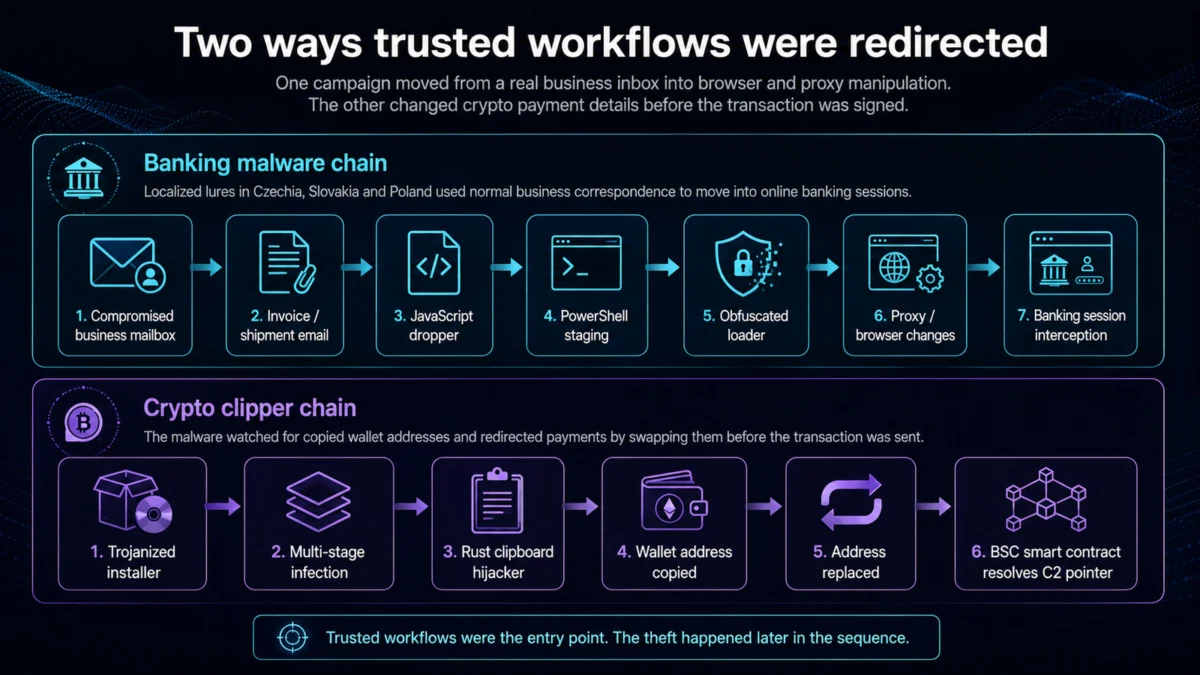
Gen Digital’s H1 2026 Threat Report details two highly concerning attack campaigns that circumvented traditional security measures by leveraging compromised legitimate accounts, manipulated browser settings, and innovative uses of blockchain technology. These sophisticated operations, tracked by Gen Threat Labs, highlight a concerning evolution in cybercriminal tactics, moving beyond brute-force methods to exploit the very trust mechanisms users and systems rely upon. The report, a semi-annual deep dive into the evolving threat landscape, paints a stark picture of the challenges consumers and businesses face in an increasingly interconnected digital world.
Key Findings and Scope of Threats
The first half of 2026 saw a significant prevalence of scams, accounting for nearly 46% of all Gen threat detections. Malvertising, a persistent menace, represented another substantial portion, nearing 30%. Gen’s security solutions were instrumental in blocking an overwhelming 114.2 million e-shop scam attacks and 20.3 million tech support scam attempts during this period. While these raw numbers underscore the sheer volume of threats, they often obscure the intricate pathways attackers employ to achieve their objectives. The Gen report emphasizes that a simple detection count fails to illustrate the nuanced progression of an attack, from the initial lure and script execution to the subtle manipulation of browser settings or the covert replacement of cryptocurrency wallet addresses before a victim authorizes a transaction.
Deep Dive into Two Illustrative Campaigns
To illuminate these advanced tactics, Gen Threat Labs meticulously investigated two distinct, yet equally alarming, H1 2026 campaigns. The first targeted individuals through a banking malware operation, meticulously orchestrated to begin with compromised corporate email accounts and culminating in the insidious alteration of proxy and browser settings. The second campaign focused on the burgeoning cryptocurrency space, employing a Rust-based clipboard hijacker that ingeniously retrieved command-and-control (C2) infrastructure details from the Binance Smart Chain, a testament to attackers’ adaptability in leveraging decentralized technologies.
Campaign 1: The Business Email Deception
The banking malware campaign, which primarily affected users in Czechia, Slovakia, Poland, and Lithuania, masterfully exploited the perceived legitimacy of business communications. The initial lures were designed to appear as routine professional correspondence, including simulated shipment notices, invoice-related messages, and notifications about scanned documents. In a particularly concerning tactic, several of these malicious emails were dispatched directly from compromised corporate mailboxes. This meant the messages were not merely impersonating legitimate companies but were genuinely originating from accounts that cybercriminals had already infiltrated.
This approach effectively bypassed crucial security layers. Email authentication protocols like SPF (Sender Policy Framework) and DKIM (DomainKeys Identified Mail) can still authenticate messages sent through authorized infrastructure, even if that infrastructure has been compromised. Furthermore, reputation systems, which often rely on historical sender data, would likely still view the compromised account as having a legitimate track record, further reducing suspicion.
Once a victim opened the malicious attachment, a sophisticated chain of execution was initiated. The attachment launched a JavaScript dropper, which then progressed through multiple PowerShell stages before ultimately deploying shellcode with banking-specific functionalities. Analysis of the available indicators strongly suggested the involvement of GepyS, a known banking trojan. The malware’s ultimate objective was to gain proximity to the victim’s online banking sessions through the modification of proxy settings and the installation of a malicious browser add-on.
The simplified attack chain for this campaign can be visualized as follows:
- Compromised Mailbox: The initial point of entry, leveraging an existing, trusted corporate email account.
- JavaScript Dropper: The first stage of malicious code, executed upon opening the attachment.
- PowerShell Stages: A series of scripts that further escalate privileges and download additional malicious components.
- Shellcode Loader: A component responsible for decrypting and executing the final payload.
- Proxy and Browser Manipulation: The final stage, altering network settings and browser behavior to facilitate banking fraud.
One of the stage-three payloads utilized a 32-bit position-independent loader. Detailed static analysis revealed sophisticated obfuscation techniques, including the insertion of MMX and SSE junk instructions, jumps into the middle of instruction sequences, and a decryption routine that employed an LFSR (Linear Feedback Shift Register)-generated keystream followed by XOR operations. While individually these techniques are not novel, their combined application significantly increased the complexity, rendering rapid static analysis less effective and prolonging the detection process.
Crucially, the success of this banking campaign hinged on a relatively simple initial user action: opening an attachment. The subsequent stages, involving JavaScript and PowerShell, handled the complex process of staging and downloading malware. The loader served to deliberately slow down analysis efforts, while the proxy and browser modifications seamlessly integrated the operation into the victim’s banking session, making it appear as a legitimate user activity.
Comparable campaigns observed in H1 2026 shared similar regional and operational patterns, albeit with different payloads. In Italy, for instance, fake invoice PDFs, including lures themed around Booking.com, led to Vercel-hosted scripts employing per-victim JavaScript obfuscation. These were often followed by PowerShell stages hosted on Blogspot, ultimately delivering XWorm, a remote access trojan. In Poland, invoice-themed phishing attacks delivered a steganographic .NET loader, which in turn installed Remcos RAT, another potent remote access tool. These variations underscore the attackers’ flexibility in adapting their toolkits while maintaining the core strategy of exploiting trusted communication channels.
Campaign 2: The Blockchain-Enabled Clipboard Hijacking
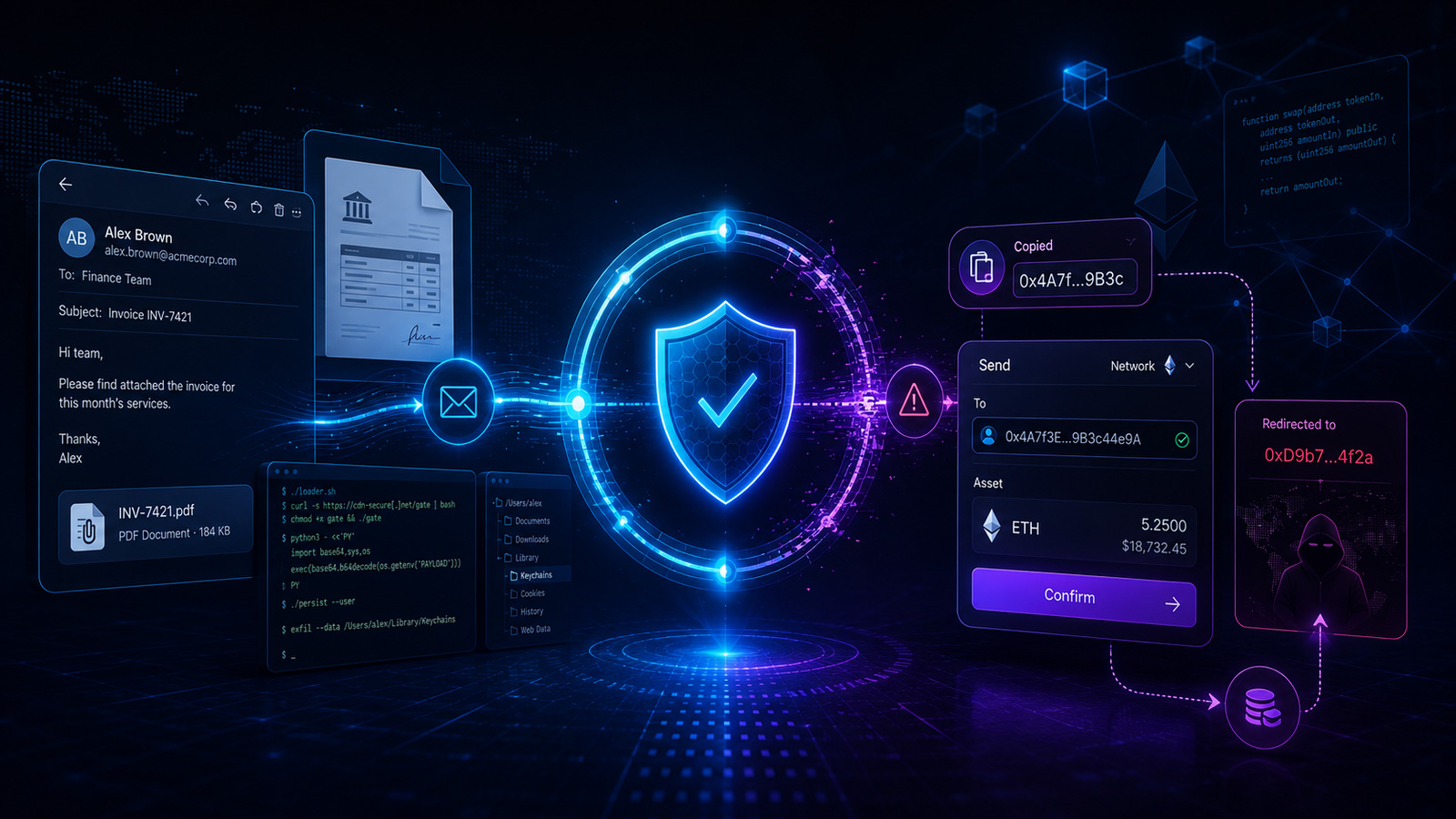
The second campaign, while also highly impactful, targeted a different user interaction: the simple act of copying and pasting a cryptocurrency address. The final payload in this operation was a Rust-compiled clipboard hijacker. This malware was designed to continuously monitor the system’s clipboard for copied content. Upon detecting a cryptocurrency wallet address across 21 different blockchain types, including prominent ones like Bitcoin (BTC), Ethereum (ETH), and Litecoin (LTC), it would silently replace the copied address with one controlled by the attacker.
From the victim’s perspective, the transaction process could appear entirely normal. They would copy their intended recipient’s address, paste it into their cryptocurrency wallet or exchange interface, and proceed to authorize the payment. The underlying blockchain itself remained uncompromised, and the cryptographic security of the wallet was not breached. The transaction was technically valid, but the destination address had been subtly altered locally before the user finalized the transaction signing process.
The vulnerability exploited here lies in the inherent complexity of cryptocurrency addresses. These addresses are typically long, visually noisy strings of characters that are difficult for humans to verify at a glance. Many users, in their haste or due to a lack of rigorous verification practices, often check only the first and last few characters of an address. This limited visual inspection provides attackers with sufficient leeway to substitute their own wallet addresses, which might share superficial similarities with the legitimate ones, thereby evading casual scrutiny.
Adding another layer of sophistication, the command-and-control infrastructure for this malware was ingeniously designed. Instead of relying on easily discoverable hardcoded IP addresses or domains, the malware utilized the Binance Smart Chain as part of its C2 resolution mechanism, employing a technique known as EtherHiding. The attackers did not store the entire backend infrastructure on the blockchain. Instead, they embedded pointers to their C2 infrastructure within data stored in a smart contract. The malware would then read these pointers from the publicly accessible smart contract data, using them to establish communication with the attacker-controlled infrastructure.
This decentralized C2 approach presented significant challenges for defenders. While a resolved domain, URL, or IP address could be blocked or taken down through traditional methods, the underlying smart contract data remained publicly readable. This made it a persistent and difficult-to-remove element, serving as a valuable investigative pivot point. Consequently, a simple list of network Indicators of Compromise (IoCs) would quickly become outdated and ineffective. The entire investigative chain – from the contract address and the method used to read its data, to the returned value and the subsequent infrastructure reached – needed to be considered as interconnected components.
Implications and Defense Strategies
The implications of these sophisticated attack vectors are profound. They demonstrate a clear shift from exploiting software vulnerabilities to exploiting human trust and the inherent complexities of digital systems.
For the banking campaign, effective detection requires a holistic approach that marries sender authentication with robust post-delivery telemetry. The sequence of events – an attachment launching JavaScript, PowerShell scripts retrieving further stages, shellcode execution, and subsequent modifications to proxy settings and browser extensions – must be correlated as a single, continuous attack sequence rather than being treated as isolated, unrelated incidents. A legitimate sender’s historical reputation should not diminish the priority assigned to an investigation if the mailbox itself has been compromised.
Organizations can implement several proactive measures:
- Restrict Script Interpreters: Where operationally feasible, limiting the use of script interpreters for users who do not require them can reduce the attack surface.
- Application Control Policies: Enforcing application control policies on downloaded attachments can prevent the execution of unauthorized scripts.
- Alert on Unexpected Changes: Implementing alerts for unexpected changes in proxy settings or the installation of new browser extensions can provide early warnings of compromise.
- Monitor Mailbox Takeover: Continuous monitoring for mailbox takeover remains a critical component of detection, as compromised accounts serve as the initial delivery infrastructure.
For the cryptocurrency campaign, defenders must expand their monitoring capabilities. This includes tracking processes that modify clipboard content, implementing pattern matching for wallet addresses, and scrutinizing blockchain queries originating from applications that have no legitimate need to perform them. The smart contract pointer and the infrastructure it resolves should be monitored in tandem, rather than treating the current C2 domain as the sole indicator of compromise.
Users engaging in cryptocurrency transactions are strongly advised to:
- Verify Full Destination: Always verify the complete destination address displayed by the signing device or wallet immediately before approving any transaction.
- Utilize Address Books and Allowlists: Employing address books or allowlists for frequent recipients can reduce the need for manual entry and the associated risks.
- Thoroughly Compare Changed Destinations: For first-time or changed destinations, a full character-by-character comparison is essential, rather than a superficial check of the opening and closing characters.
In both these campaigns, the initial point of trust, whether an authenticated email or a copied value, could appear entirely legitimate. However, the surrounding workflow had already been compromised. Effective detection and verification strategies must therefore encompass the entire sequence of actions, bridging the gap between the seemingly innocuous initial interaction and the final, potentially fraudulent, action.
Gen Digital’s comprehensive H1 2026 Threat Report delves deeper into these and other critical areas, including scams, malware, identity exposure, privacy concerns, and the growing impact of AI-driven threats. The full report provides extensive telemetry, detailed case studies, and actionable guidance on how sophisticated attacks are increasingly navigating and subverting trusted workflows.
Read the full Gen H1 2026 Threat Report here.
Sponsored and written by Gen Digital.