Sisilia Frederika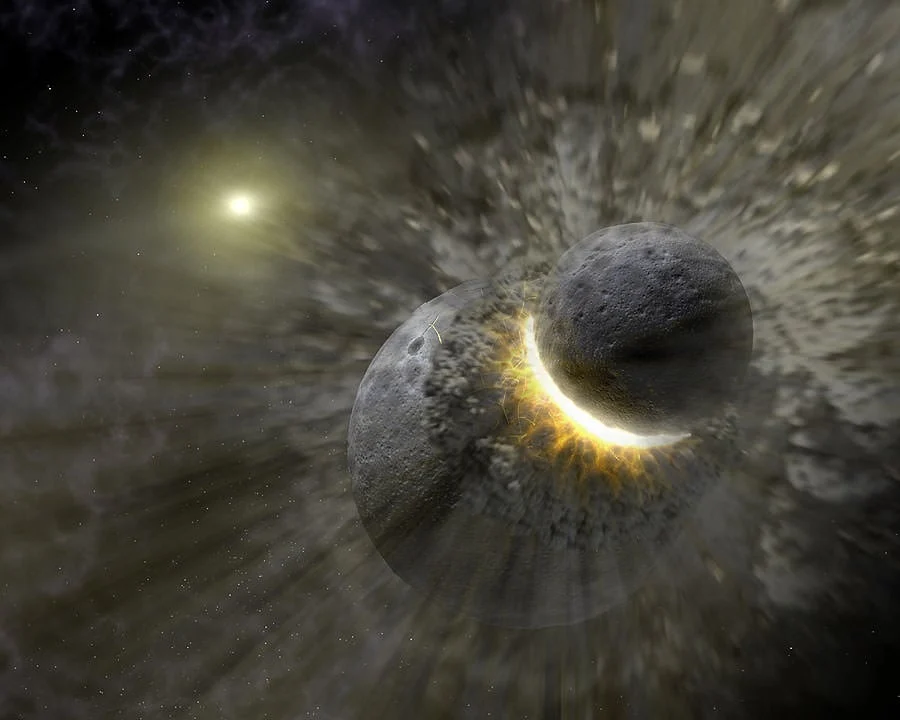
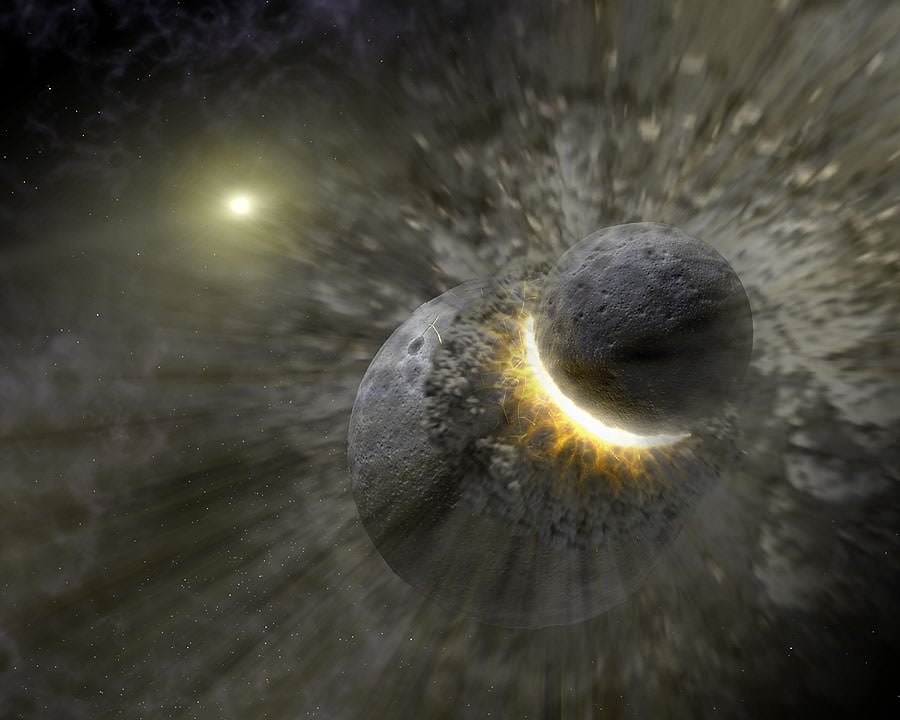
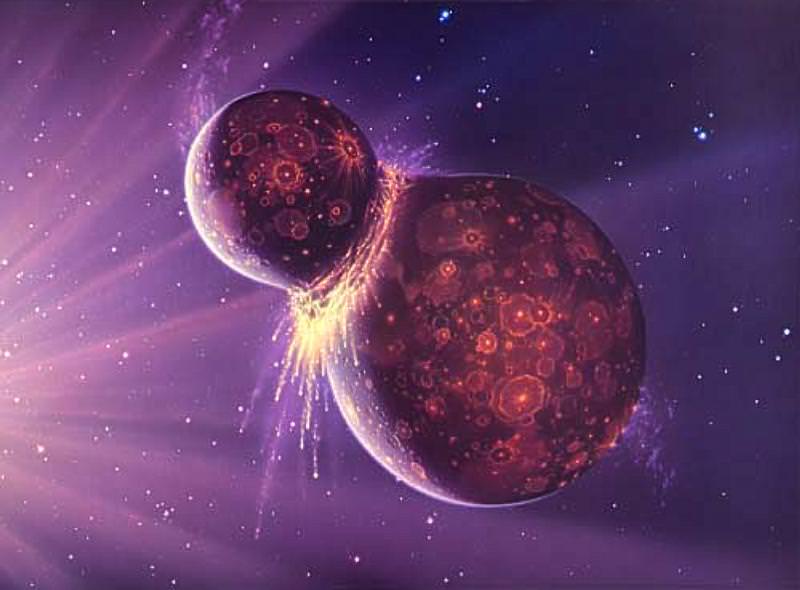
The origin of Earth’s Moon has long been attributed to a singular, violent event known as the Giant Impact Hypothesis, which posits that a Mars-sized protoplanet named Theia collided with the early Earth approximately 4.5 billion years ago. While this theory has remained the cornerstone of lunar science for decades, new research published in The Astrophysical Journal Letters suggests that our understanding of this cataclysmic event has been incomplete. Led by Dr. Adeene Denton, a postdoctoral researcher at the Southwest Research Institute (SwRI), the study reveals that the physical strength of the colliding bodies—determined largely by their internal temperatures—played a decisive role in whether the Moon formed from a slow-moving debris disk or emerged nearly intact within a matter of hours.
By employing advanced smoothed-particle hydrodynamics (SPH) simulations that incorporate realistic material strength for the first time, the research team has challenged the "canonical" view of Moon formation. Historically, scientists assumed that the energy involved in such a massive collision would be so immense that all materials would behave like fluids, rendering their structural strength irrelevant. However, Dr. Denton’s models demonstrate that the outer hundreds of kilometers of a cooling protoplanet retain enough shear resistance to fundamentally alter the transfer of momentum during the impact, leading to entirely different evolutionary outcomes for the Earth-Moon system.
The Mechanics of the Giant Impact: Fluid vs. Solid Dynamics
The Giant Impact Hypothesis (GIH) traditionally suggests that the collision between the proto-Earth and a differentiated Theia produced a massive, iron-poor disk of vaporized and molten debris. Over time, this disk would have cooled and accreted to form the Moon. This "canonical" model has been the gold standard because it explains the Moon’s lack of a large iron core and its low density. Yet, it struggles to explain the isotopic "fingerprint" of the Moon, which is nearly identical to Earth’s, despite models suggesting the Moon should be composed mostly of Theia’s material.
The new research by Dr. Denton and her colleagues introduces a critical variable: temperature-dependent material strength. In planetary science, "strength" refers to a material’s ability to resist deformation and shear. As a rocky body cools, its material strength increases. The study found that if Theia was relatively cool and "strong" at the time of impact, it would not have completely disintegrated into a disk. Instead, a large portion of Theia could have survived the collision as a coherent mass, being captured into Earth’s orbit as a mostly intact satellite.
This shift in perspective is significant because it links the timing of the Moon’s formation to the thermal history of the early solar system. If the impact occurred very early when both bodies were still molten or extremely hot, the result would be the classic debris disk. If the impact occurred later, after the bodies had sufficient time to cool and harden, the "intact capture" scenario becomes more likely.
A Chronology of Lunar Origin Theories
The quest to understand how the Moon formed has evolved through several distinct phases of scientific inquiry, beginning with the return of lunar samples during the Apollo era.
- The Pre-Apollo Era (Before 1969): Three primary theories dominated: fission (the Moon broke off from a rapidly spinning Earth), capture (the Moon formed elsewhere and was snagged by Earth’s gravity), and co-accretion (they formed together from the same dust cloud).
- The Rise of the Giant Impact (1975–1984): Following the analysis of Apollo rocks, which showed the Moon was bone-dry and lacked iron, William K. Hartmann and Donald R. Davis proposed the Giant Impact. This theory gained widespread acceptance at the 1984 Kona Conference on lunar origins.
- The Canonical Modeling Era (1990s–2010s): Early computer simulations, such as those by Dr. Robin Canup, established the "standard" parameters: a glancing blow by a Mars-sized object that created a disk.
- The Isotopic Crisis (2010s–Present): High-precision measurements of oxygen, titanium, and tungsten isotopes revealed that Earth and the Moon are isotopic twins. This contradicted models showing the Moon should be 70-90% Theia material.
- The Integration of Material Strength (2024): Dr. Denton’s research represents the latest evolution, moving beyond fluid dynamics to include the complex physics of solid-state materials in high-energy collisions.
Supporting Data: The Role of Accretion and Momentum
The simulations conducted by the SwRI team utilized a sophisticated code to compare "fluid" impacts with "strength-based" impacts under identical initial conditions. The data revealed a stark contrast in the distribution of mass following the collision.
In the fluid-only simulations—which represent a very hot, molten Theia—Earth accreted approximately 91% of Theia’s mass. The remaining material formed a melt-dominated debris disk, with no single fragment larger than 2% of Theia’s original mass. This result aligns with the traditional view that the Moon must slowly "grow" from the disk over thousands of years.
However, when temperature-dependent strength was added to the model to simulate a cooler, solid Theia, the outcome changed dramatically. In this scenario, Earth accreted only 84% of Theia directly. The added resistance to shear in the outer layers of the protoplanet prevented its total pulverization. Consequently, a large, intact remnant of Theia, roughly the mass of the Moon, was captured into orbit. This process happened with incredible speed, with an intact Moon emerging in as little as five hours.
This data suggests that the "window" for Moon formation is narrower than previously thought. The physical state of the planets—whether they were "soft" or "hard"—dictates the very nature of the satellite system that remains.
Perspectives from the Scientific Community
The findings have sparked significant interest among planetary scientists, offering a potential bridge between the dynamical models of physics and the geochemical realities of the Moon.
Dr. Adeene Denton emphasized that while material strength is a known factor in collisions between small asteroids, its relevance to planetary-scale impacts was previously dismissed. "We weren’t sure if it would matter for the Moon or not," Denton noted in a statement released by SwRI. "When we did the simulations, we found it actually matters quite a bit. Depending on how hot the Earth and Theia are prior to the collision, the impact can destroy Theia or produce an intact Moon."
Dr. Robin Canup, Vice President of SwRI’s Solar System Science and Exploration Division and a pioneer in Moon formation research, praised the study’s implications. "These surprising and exciting new results imply a potential connection between the physical properties of the Moon today, including perhaps its volatile content, and the thermal state of the Earth and Theia at the time of the giant impact," Canup stated. She noted that this research provides a new tool for scientists to "constrain when the Moon-forming event occurred," as it links the physical structure of the Moon to the cooling rates of the early solar system.
Broader Implications and the Isotopic Paradox
One of the most persistent "holy grails" in lunar science is resolving the isotopic similarity between Earth and the Moon. If the Moon formed from a debris disk that was mostly Theia, why does it look exactly like Earth’s mantle at a molecular level?
The "intact capture" scenario enabled by material strength adds a new layer to this puzzle. If a large portion of Theia survived to become the Moon, the geochemical composition of Theia itself becomes the central question. If Theia and Earth formed in the same "neighborhood" of the solar system—sharing the same reservoir of isotopes—then an intact capture of Theia would naturally result in an Earth-Moon pair with identical isotopic signatures.
Furthermore, this research has implications for the study of exoplanets. As astronomers discover more rocky planets orbiting distant stars, understanding how those planets form satellites becomes crucial. The "strength" of a planet is a function of its age and its distance from its host star (which affects its temperature). Dr. Denton’s work suggests that older, cooler planetary systems may be more likely to have "captured" intact moons, whereas younger, hotter systems might be surrounded by massive debris disks or rings that eventually coalesce into multiple smaller satellites.
Conclusion: A New Frontier in Lunar Evolution
The study titled "Collisional Capture of an Intact Moon Depends on Strength" marks a turning point in the field of planetary defense and origins. It moves the conversation from simple "splat" models to a more nuanced understanding of how the internal heat of a world dictates its destiny.
While the Giant Impact Hypothesis remains the most viable explanation for the Moon’s existence, the inclusion of material strength suggests that the Moon may be a "survivor" rather than a "reconstruction." By proving that the Moon could have formed as an intact body in just a few hours, the research challenges the long-held assumption that planetary formation is always a slow, gradual process of accretion.
As scientists continue to refine these models and compare them with the data expected from upcoming lunar missions, such as NASA’s Artemis program, the story of our Moon’s birth continues to grow more complex and fascinating. The cold, silent Moon we see today may very well be a direct relic of a "strong" Theia that refused to be completely broken 4.5 billion years ago.