admin
admin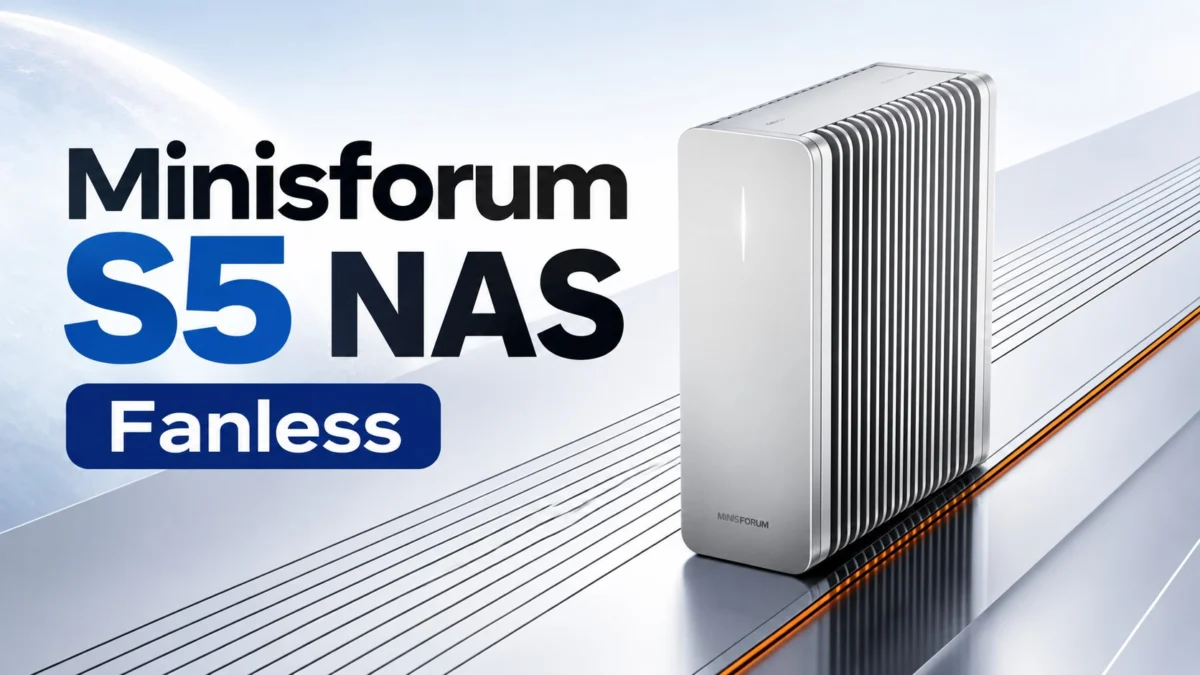
A New Paradigm in Silent Storage Architecture
The Minisforum S5 enters a market increasingly dominated by flash storage, as the declining cost per gigabyte of NVMe SSDs makes all-flash arrays more accessible to the general public. Unlike traditional NAS units that rely on spinning mechanical hard drives and loud cooling fans, the S5 is designed for absolute silence. The device’s primary value proposition lies in its fully passive cooling system. Encased in a robust aluminum chassis that measures just 176.5 x 60 x 154 mm, the exterior of the unit serves as a massive heat sink. This design choice eliminates the mechanical failure points associated with cooling fans and ensures that the device can be placed in noise-sensitive environments, such as recording studios, bedrooms, or shared office spaces, without causing a distraction.
The engineering required to maintain a fanless design while supporting high-speed networking and multiple NVMe drives is significant. Aluminum’s high thermal conductivity allows the heat generated by the CPU and the internal SSDs to be drawn toward the ribbed outer shell, where it is dissipated through natural convection. This approach, while effective for low-power components, dictates the specific hardware choices found within the S5, most notably the selection of the Intel Core 3 304 processor.
Technical Deep Dive: The Intel Core 3 304 and Wildcat Lake
At the core of the S5 is the Intel Core 3 304, a member of the "Wildcat Lake" family. This processor is specifically engineered for efficiency and low-power applications, featuring a total of five cores. The architecture utilizes a hybrid design consisting of one "Cougar Cove" Performance-core (P-core) and four "Darkmont" Low-Power Efficient-cores (LP-E cores). This configuration is optimized for background tasks and steady-state workloads typical of a NAS environment, where the demand for massive multi-core bursts is often secondary to consistent, low-latency performance and energy efficiency.
The Core 3 304 operates with a base power of just 15W. This low Thermal Design Power (TDP) is the catalyst for the S5’s fanless design. While the processor is technically the entry-level offering within its family, it provides sufficient overhead for managing high-speed networking protocols, file system operations (such as ZFS or BTRFS), and even lightweight containerized applications via Docker. However, users should note that because it is a low-power part, the S5 is not intended for heavy video transcoding or complex virtual machine hosting that requires significant multi-threaded performance.

Storage Configuration and Bandwidth Trade-offs
The defining feature of the Minisforum S5 is its five M.2 2280 SSD slots. In an era where data density is paramount, the S5 allows users to install up to 40 TB of total storage by utilizing five 8 TB NVMe drives. This capacity is staggering for a device of this physical footprint, providing a high-speed alternative to bulky, four-bay 3.5-inch HDD enclosures.
However, the storage architecture comes with a specific technical caveat. While the slots support the PCIe 4.0 interface, internal reports and technical specifications indicate that each slot is limited to a PCIe 4.0 x1 lane. In a standard PC, an NVMe slot typically utilizes four lanes (x4), allowing for sequential read speeds in excess of 7,000 MB/s. By limiting each slot to a single lane, the maximum theoretical bandwidth per drive is capped at approximately 1.97 GB/s.
While this may seem like a significant bottleneck for enthusiasts accustomed to flagship SSD speeds, in the context of a NAS, it remains more than adequate. A single PCIe 4.0 x1 connection still vastly outperforms the 550 MB/s limit of SATA SSDs and the 250 MB/s limit of mechanical hard drives. Furthermore, since the primary bottleneck for most NAS users is the network connection—even a 10 GbE link caps out at roughly 1.25 GB/s—the x1 per-slot limitation will rarely be the deciding factor in real-world file transfer speeds.
Networking and External Connectivity
Minisforum has equipped the S5 with a comprehensive array of modern connectivity options to ensure it can integrate into high-end network infrastructures. The device features a dual-LAN configuration, comprising one 10 GbE (10 Gigabit Ethernet) port and one 2.5 GbE port. The inclusion of 10 GbE is a critical addition for an all-flash NAS, as it allows the user to actually utilize the speed of the NVMe drives for large file transfers across a local network.
For wireless connectivity, the S5 is at the forefront of the industry, incorporating a WiFi 7 adapter. This provides ultra-low latency and high-throughput wireless access, which is particularly beneficial for users who may not have the ability to run Ethernet cables to every corner of their workspace.

The I/O panel is further bolstered by dual USB4 ports. These ports support up to 40 Gbps of bandwidth, making them ideal for connecting external RAID arrays, high-speed DAS (Direct Attached Storage) units, or even external GPU enclosures for specialized tasks. Multiple USB Type-A ports are also available for connecting peripherals such as keyboards, mice, or legacy external drives.
The Software Ecosystem and AI Integration
One of the more intriguing aspects of the Minisforum S5 launch is the marketing emphasis on "AI NAS" capabilities. Promotional materials highlight features such as "MinisOpenClaw" and a "Local AI Assistant." While the Intel Core 3 304 does not possess a high-end dedicated NPU (Neural Processing Unit) like the more expensive Ultra series chips, it is capable of handling basic AI-driven tasks locally.
This suggests that Minisforum may be shipping the S5 with a custom software suite designed to leverage local machine learning for tasks such as automated photo categorization, facial recognition within media libraries, and intelligent search functions. By keeping these tasks local to the NAS rather than offloading them to the cloud, Minisforum is appealing to privacy-conscious users who want the benefits of AI without the data-sharing risks associated with third-party services.
Chronology and Market Availability
The announcement of the Minisforum S5 follows a period of rapid expansion for the company. Known primarily for its ultra-compact mini-PCs, Minisforum began diversifying into the NAS space over the last 18 months, responding to a growing community of "data hoarders" and home lab hobbyists who were repurposing mini-PCs as servers.
As of this writing, Minisforum has officially listed the S5 on its website, though specific pricing tiers for different RAM and storage configurations (or barebone options) have yet to be finalized. The company is currently in the "early access" phase, allowing interested customers to sign up for updates and potential early-bird discounts. Historically, Minisforum has utilized crowdfunding platforms or direct web-store pre-orders for its niche launches, and a similar rollout is expected for the S5 in the coming weeks.

Comparative Analysis: NAS vs. Mini-PC
The S5 occupies a unique middle ground between a traditional NAS and a high-end Mini-PC. Compared to established NAS brands like Synology or QNAP, the Minisforum S5 offers superior raw hardware specs for the price—specifically the inclusion of 10 GbE and USB4, which are often expensive add-ons or reserved for enterprise models in the traditional NAS market.
However, the success of the S5 will largely depend on its software stability. Traditional NAS manufacturers provide highly polished, proprietary operating systems (like DiskStation Manager). Minisforum, conversely, often relies on the user’s ability to install and configure open-source solutions like TrueNAS, Unraid, or Proxmox. For the enthusiast market, this flexibility is a feature; for the average consumer, it may be a hurdle.
Implications for the Industry
The launch of the S5 is a clear indicator that the industry is moving away from the "slow and steady" approach to consumer storage. By prioritizing NVMe slots over SATA bays, Minisforum is betting on a future where physical size and noise are the primary constraints for home users. The decision to use the Intel Core 3 304 reflects a calculated balance: providing enough power to saturate a 10 GbE line while keeping the system cool enough to function without a fan.
Furthermore, the inclusion of WiFi 7 and USB4 suggests that the S5 is intended to be a "hub" for a modern digital life, capable of handling everything from high-speed backups to serving as a local AI node. As more manufacturers follow this trend, the line between a personal computer and a storage server will continue to blur, leading to a more integrated and silent home computing environment.
In conclusion, the Minisforum S5 stands as a bold experiment in thermal engineering and storage density. While the PCIe lane limitations and the entry-level CPU might give some performance purists pause, the combination of five NVMe slots, 10 GbE networking, and a completely silent footprint makes it a formidable contender in the evolving landscape of personal data management.