Sisilia Frederika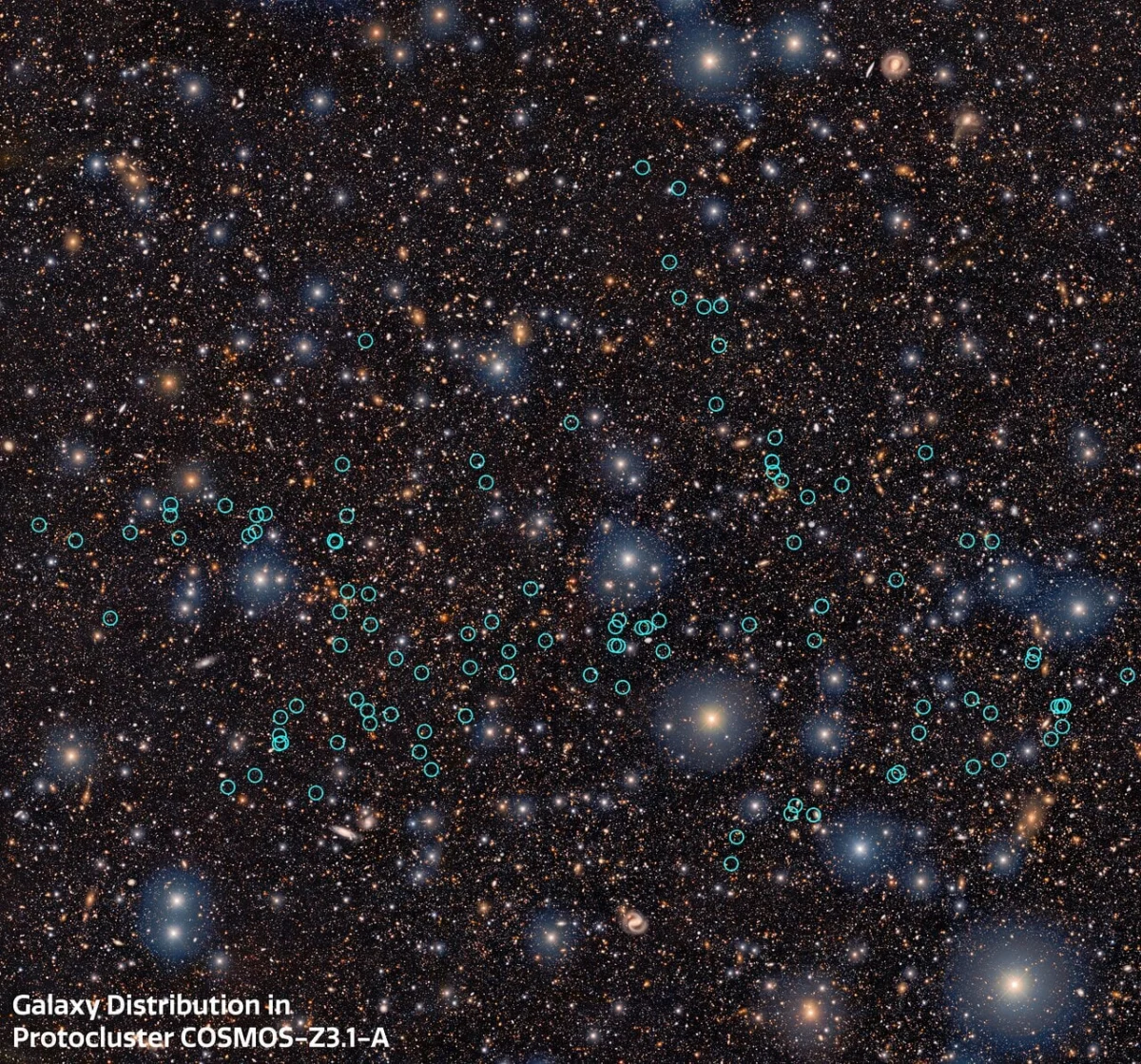
Deep within the cosmic dawn, at a time when the universe was barely 15% of its current age, a massive architectural feat of gravity was already taking shape. A team of international astronomers, utilizing one of the world’s most powerful wide-field imaging tools, has identified a colossal galaxy proto-supercluster named COSMOS-z3.1-A. Observed as it existed approximately 12 billion years ago, this structure represents the most distant and earliest example of a burgeoning supercluster ever recorded. The discovery, made through the analysis of data from the One-hundred-deg2 DECam Imaging in Narrowbands (ODIN) survey, provides an unprecedented window into the formative years of the Cosmic Web—the vast, invisible scaffolding of dark matter and gas that dictates the distribution of all matter in the cosmos.
The Scale and Scope of COSMOS-z3.1-A
The discovery of COSMOS-z3.1-A challenges previous assumptions regarding the speed at which the largest structures in the universe can assemble. At a redshift of approximately 3.1, the light from this proto-supercluster has traveled for 12 billion years to reach Earth’s telescopes. When this light was emitted, the universe was a tumultuous environment of rapid star formation and violent galactic mergers.
COSMOS-z3.1-A is not a single entity but a "proto-supercluster"—a loose, sprawling collection of galaxies and smaller clusters that were, at the time of observation, in the process of being drawn together by gravity. Data indicates that the structure consists of at least 10 distinct, high-density groups of galaxies. These groups were individual protoclusters that would eventually coalesce into a single, gravitationally bound supercluster.
The sheer mass of the structure is perhaps its most staggering attribute. Initial estimates suggest COSMOS-z3.1-A possesses a mass roughly 5,000 times that of our own Milky Way galaxy. Vandana Ramakrishnan, a graduate student at Purdue University who led the discovery team, noted the rarity of such an object. According to the team’s analysis, COSMOS-z3.1-A represents an extreme "overdensity" in the early universe. Calculations suggest that for every 10,000 galaxy clusters found in the cosmos, fewer than one would match the scale and density of this specific proto-supercluster at such an early epoch.
The ODIN Survey and the Victor M. Blanco Telescope
The identification of COSMOS-z3.1-A was made possible by the ODIN survey, an ambitious observational project conducted over 100 nights across a three-year period. The survey utilized the Dark Energy Camera (DECam), a 520-megapixel high-performance imager mounted on the 4-meter Victor M. Blanco Telescope at the Cerro Tololo Inter-American Observatory (CTIO) in Chile.
The ODIN survey was specifically designed to peer into the deep past by using narrowband filters. These filters allow astronomers to isolate specific wavelengths of light, such as the Lyman-alpha emission from hydrogen gas, which is a hallmark of young, star-forming galaxies in the early universe. By focusing on these specific signals, the survey was able to map the three-dimensional distribution of galaxies across a massive volume of space.
In total, the ODIN survey identified approximately 150 distant protoclusters dating back to the first three billion years of cosmic history. However, COSMOS-z3.1-A stands out as the most significant "complex" within this dataset. The survey’s ability to capture such deep images of the southern hemisphere sky has provided a census of early cosmic structures that was previously impossible with smaller-scale observations.
A Chronology of Cosmic Construction
To understand the significance of COSMOS-z3.1-A, it is necessary to view it within the timeline of the "bottom-up" or hierarchical model of cosmic evolution. This model suggests that the universe did not begin with large structures, but rather built them over billions of years.
- The Big Bang (13.8 Billion Years Ago): The universe begins as an incredibly hot, dense point.
- Recombination (380,000 Years After Big Bang): The universe cools enough for protons and electrons to form neutral hydrogen atoms, allowing light to travel freely.
- The Dark Ages: No stars yet exist. Dark matter begins to clump together due to tiny fluctuations in density.
- First Stars and Galaxies (200–400 Million Years After Big Bang): Gas collapses into the first stars, which then group into small, irregular galaxies.
- The Era of COSMOS-z3.1-A (2 Billion Years After Big Bang): These early galaxies are drawn together by the gravitational pull of dark matter filaments. COSMOS-z3.1-A is seen at this stage—a massive "construction site" where 10 dense groups are merging.
- The Modern Universe (Today): These early mergers have resulted in the massive, rounded galaxy clusters and superclusters we see in our local neighborhood, such as the Virgo Supercluster.
The ODIN data provides a "snapshot" of step five, showing that even just two billion years after the Big Bang, gravity had already succeeded in corralling thousands of galaxies into a singular, interconnected web.
Mapping the Cosmic Web and Dark Matter
One of the most vital aspects of the research led by Ramakrishnan and her colleagues is the mapping of the Cosmic Web. The Cosmic Web is a network of filaments—primarily composed of dark matter—that spans the entire observable universe. Galaxies and galaxy clusters are found at the nodes where these filaments intersect.
The 3D maps generated from the ODIN data reveal that COSMOS-z3.1-A is not a neat, spherical object. Instead, it is clumpy and irregularly shaped, with its 10 constituent groups appearing to be "pegged" at the junctions of multiple cosmic filaments. This morphology provides strong evidence for the hierarchical growth of the universe. As time progressed, these irregular clumps would eventually collapse under their own gravity, smoothing out into the more symmetrical clusters observed in the nearby universe.
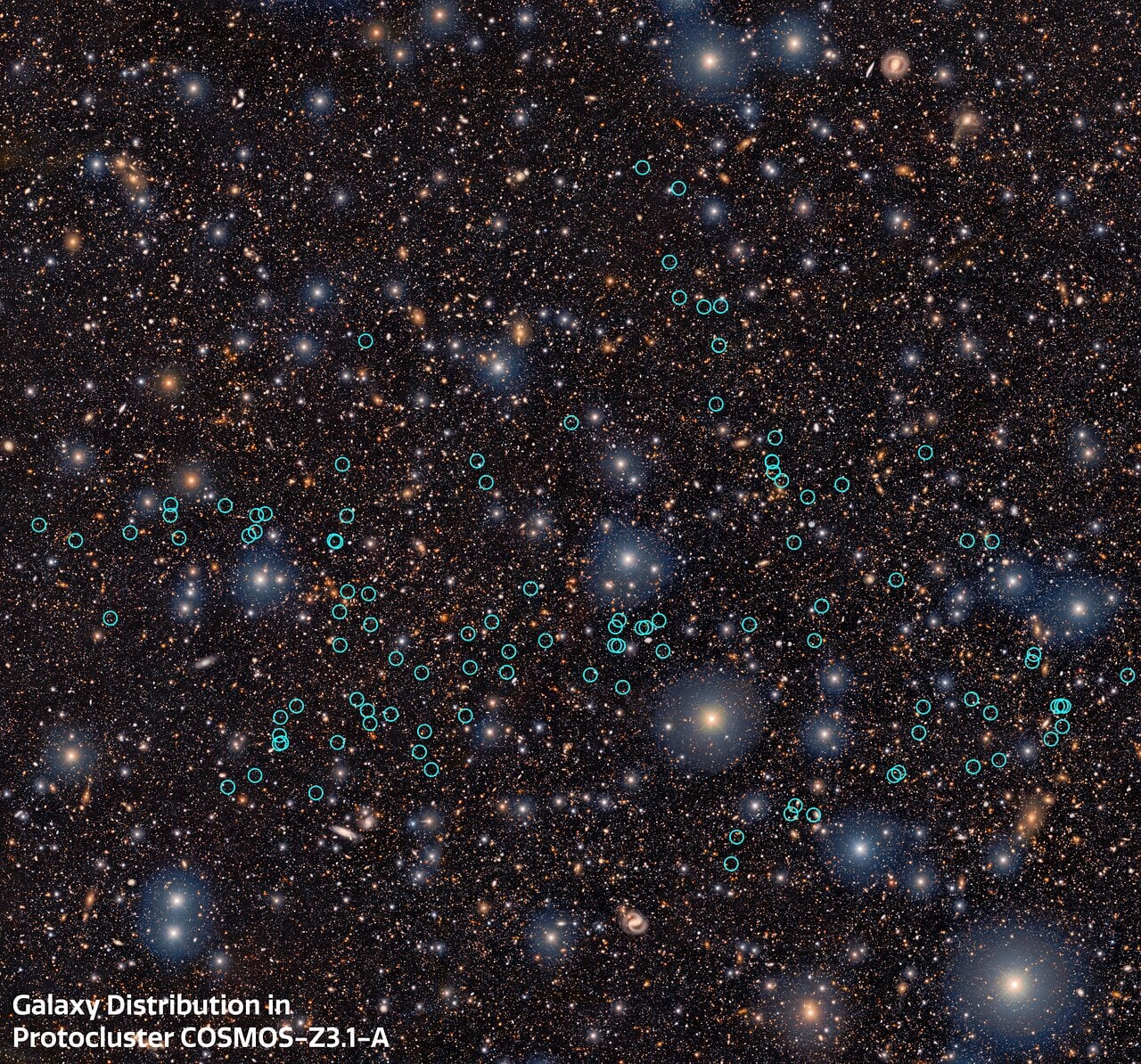
Furthermore, the presence of such a massive structure so early in time offers clues about the nature of dark matter. Because dark matter provides the gravitational "glue" that holds these structures together, the size and density of COSMOS-z3.1-A can be used to test different theories about how dark matter behaves and how it influenced the cooling and clumping of hydrogen gas in the primordial universe.
Expert Analysis and Scientific Implications
The scientific community has reacted to the discovery with a mixture of excitement and a call for further investigation into the "extreme" nature of the early universe. Eric Gawiser, an astronomer at Rutgers University and a key member of the research team, emphasized the importance of seeing the "work in progress" of cosmic evolution.
"When we look at galaxy clusters in the nearby Universe, we are seeing the finished product," Gawiser explained. "This distant structure takes us back to a much earlier stage when the individual pieces were still coming together. It allows us to study how the Universe built structures on its largest scales."
The discovery suggests that the early universe was much more active and efficient at building large-scale structures than some older models predicted. The existence of COSMOS-z3.1-A implies that the "seeds" of these superclusters—regions of slightly higher density in the very early universe—must have been significant enough to trigger rapid gravitational collapse.
Vandana Ramakrishnan highlighted the broader goals of the project: "With this project, we’re hoping to understand the growth of massive structures in the Universe and how they influence the evolution of galaxies within them. We also hope to get a better sense of how these protoclusters are connected to the larger cosmic web."
Comparative Context: From Virgo to Laniakea
To grasp the magnitude of COSMOS-z3.1-A, it is helpful to compare it to the structures we inhabit today. Our home, the Milky Way, is part of the Local Group, which is a relatively small collection of galaxies. The Local Group is situated on the outskirts of the Virgo Cluster, which contains over 1,000 galaxies.
The Virgo Cluster itself is a core component of the Virgo Supercluster, a structure spanning 150 million light-years. In the last decade, astronomers have determined that the Virgo Supercluster is merely a small branch of an even larger structure called the Laniakea Supercluster, which contains roughly 100,000 galaxies.
COSMOS-z3.1-A is essentially the "infant" version of a structure like Laniakea. While it currently appears as 10 separate groups, the laws of physics dictate that over the subsequent 12 billion years, those groups would have merged into a single, massive supercluster. By observing it in its infancy, astronomers can trace the "lineage" of the giant structures that define our current cosmic landscape.
Future Research and the Rubin Observatory
The discovery of COSMOS-z3.1-A is likely only the beginning of a new era in high-redshift astronomy. While the ODIN survey has provided a significant leap forward, upcoming facilities are expected to refine these findings.
The Vera C. Rubin Observatory, currently under construction in Chile, will conduct the Legacy Survey of Space and Time (LSST). This survey will image the entire southern sky every few nights for a decade, providing a "movie" of the universe. The Rubin Observatory’s 8.4-meter primary mirror and 3,200-megapixel camera will likely uncover thousands of structures similar to COSMOS-z3.1-A, allowing astronomers to move from studying individual "record-breakers" to performing statistical analyses of the entire population of early superclusters.
Additionally, space-based observatories like the James Webb Space Telescope (JWST) and the European Space Agency’s Euclid mission will provide higher-resolution views of the individual galaxies within COSMOS-z3.1-A. This will allow researchers to study how the environment of a massive proto-supercluster affects the birth of stars and the growth of supermassive black holes at the centers of these ancient galaxies.
As astronomers continue to peel back the layers of cosmic time, structures like COSMOS-z3.1-A serve as vital landmarks. They confirm that the universe, even in its earliest stages, was a place of immense complexity and order, driven by the invisible hand of dark matter and the relentless pull of gravity. The study of this proto-supercluster does more than just break a distance record; it provides a foundational chapter in the biography of the universe itself.