Sisilia Frederika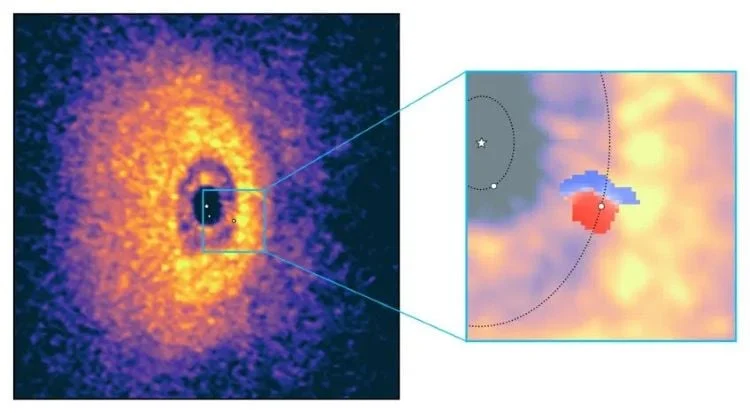
In a milestone for observational astronomy, an international team of researchers has captured the first direct images of protoplanets actively shaping their environment within a massive disk of gas and dust. This breakthrough, centered on the WISPIT 2 system located approximately 430 light-years from Earth, provides the most definitive evidence to date of the complex dynamics involved in the formation of giant planets. By utilizing the unprecedented resolution of the Atacama Large Millimeter/submillimeter Array (ALMA) in northern Chile, scientists have moved beyond theoretical computer simulations to witness the physical processes of accretion and disk-planet interaction in real-time. The study, recently published in The Astrophysical Journal Letters, marks a turning point in our understanding of how planetary systems—including our own—evolve from primordial dust into complex celestial architectures.
The Architecture of the WISPIT 2 System
The WISPIT 2 system has emerged as a premier natural laboratory for studying the "birth" phase of planetary evolution. At the heart of this discovery are two massive protoplanets, designated WISPIT 2b and WISPIT 2c, which are currently in the process of gathering mass from their parent disk.
WISPIT 2b, the outer companion, is situated at a distance of approximately 57 astronomical units (AU) from its host star—a distance significantly further than Neptune’s orbit in our solar system. Despite its distance, the planet is a behemoth, estimated to be five times as massive as Jupiter. What makes the imaging of WISPIT 2b particularly significant is the detection of swirling gas patterns surrounding the planet. These "swirls" are the visual manifestation of gas being funneled onto the growing planet, a phenomenon predicted by hydrodynamic simulations but never before captured with such clarity.
Interior to this sits WISPIT 2c, located at a more modest 15 AU from the host star. This protoplanet is even more massive, with estimates ranging between 8 and 12 Jupiter masses. The proximity of WISPIT 2c to the star and its immense gravitational influence have resulted in a distinct clearing of the disk material, providing a stark contrast to the environment of its outer sibling. Together, these two worlds offer a rare glimpse into the simultaneous formation of multiple giant planets within a single system.
Distinguishing Cavities and Gaps in Protoplanetary Disks
One of the most critical aspects of the ALMA data is the visual distinction between the "cavity" created by WISPIT 2c and the "gap" maintained by WISPIT 2b. In the vocabulary of astrophysics, these terms describe the degree to which a forming planet has cleared its orbital path.
A "cavity" refers to a region where the gas and dust have been almost entirely evacuated. In the case of WISPIT 2c, its massive 8-to-12 Jupiter-mass gravity has effectively "swept" the inner disk clean, creating a central hole in the primordial material. This indicates a late-stage formation process where the planet has dominated its immediate vicinity.
Conversely, WISPIT 2b is associated with a "gap." A gap represents a decrease in the density of disk material rather than a total absence. This environment allows the protoplanet to continue its growth by accreting the remaining gas and dust. The ALMA images highlight this process through the observation of red-shifted and blue-shifted gas. Using the Doppler effect, researchers identified gas moving toward the observer (blue) and away (red), confirming the three-dimensional "swirl" of material as it is pulled into the protoplanet’s gravitational well.
A Chronology of Discovery: 2025 to 2026
The revelation of the WISPIT 2 system did not happen overnight but was the result of a multi-stage observational campaign that began in the mid-2020s.
In August 2025, the astronomical community was first alerted to the existence of WISPIT 2b. Initial data suggested a significant disturbance in the outer regions of a known protoplanetary disk. As researchers refined their observations using ALMA’s high-resolution capabilities, the presence of a five-Jupiter-mass object became undeniable. This initial discovery sparked a wave of follow-up studies aimed at determining if other bodies existed within the same system.
The search bore fruit in March 2026, when the international team announced the discovery of WISPIT 2c. The realization that two massive planets were carving out different structures (a gap and a cavity) within the same disk provided the necessary data to publish the comprehensive study led by Dr. Myriam Benisty. This timeline reflects the rapid advancement of submillimeter interferometry, allowing for the transition from detection to detailed environmental analysis in less than a year.
Technological Prowess: The Role of ALMA
The success of this study is largely attributed to the technological capabilities of the Atacama Large Millimeter/submillimeter Array. Located 5,000 meters above sea level on the Chajnantor Plateau in Chile, ALMA consists of 66 high-precision antennas that work together as a single telescope—a process known as interferometry.
Directly imaging a protoplanet is an immense challenge because these objects are often shrouded in thick layers of dust that block visible light. However, at millimeter and submillimeter wavelengths, this dust becomes "transparent" or emits its own thermal radiation, allowing ALMA to see through the opaque clouds to the forming planets within.
By combining the signals from antennas spread over distances of up to 16 kilometers, ALMA achieves a spatial resolution equivalent to seeing a golf ball from 15 kilometers away. This resolution was essential for distinguishing the fine-scale gas swirls around WISPIT 2b from the general rotation of the disk. Furthermore, the sensitivity of the array allowed for the detection of the faint "kinematic signatures" (the red and blue shifts) that confirm the movement of gas onto the protoplanet.
Solving the Conundrum of Accretion
For decades, the "accretion" process has remained one of the most debated topics in planetary science. While the general theory—that small dust grains clump together to form pebbles, which then form planetesimals and eventually planets—is widely accepted, the mechanics of this transition are fraught with theoretical hurdles.
One such hurdle is the "meter-size barrier," where objects of a certain size are theoretically expected to drift into the host star due to gas drag before they can grow into planets. The direct imaging of the WISPIT 2 system provides empirical evidence of how gas dynamics can trap material in specific zones, allowing for rapid growth.
"We clearly see both planets shaping their environment," noted Dr. Myriam Benisty, Director of the Max Planck Institute for Astronomy and lead author of the study. "WISPIT 2c has carved a cavity, and WISPIT 2b a gap. Around WISPIT 2b, we find swirls of gas that had been predicted by simulations… but never actually seen before."
These observations suggest that the "swirls" or circumplanetary disks act as funnels, efficiently moving material from the larger disk onto the planet. This discovery helps bridge the gap between computer models and physical reality, providing a blueprint for how giant planets reach their massive proportions.
Broader Implications for the Search for Life
While WISPIT 2b and 2c are gas giants and unlikely to host life as we know it, their discovery has profound implications for the habitability of other systems. The formation of giant planets often dictates the delivery of water and organic materials to smaller, rocky planets closer to the star.
By understanding how these giants carve gaps and cavities, scientists can better predict where "Earth-like" planets might form and survive. In our own solar system, the migration of Jupiter and Saturn is believed to have played a critical role in the distribution of asteroids and the enrichment of Earth’s early oceans. Observing the WISPIT 2 system allows astronomers to watch a similar "grand design" unfolding in another part of the galaxy.
Furthermore, the ability to image gas dynamics in such detail opens the door for future missions. Astronomers are already looking toward the next generation of telescopes, such as the Extremely Large Telescope (ELT) and the James Webb Space Telescope (JWST), to perform spectroscopic analysis of the atmospheres of these forming worlds.
The Future of Protoplanetary Research
The discovery of the WISPIT 2 system is expected to trigger a new era of "kinematic imaging," where the focus shifts from merely finding planets to observing the motion of the material that creates them. As ALMA continues its operations, researchers anticipate finding more systems with multiple protoplanets, allowing for a statistical analysis of planet formation.
The scientific community has reacted with widespread enthusiasm. Dr. Benisty’s team has already begun planning deeper observations to search for "circumplanetary disks"—miniature versions of the larger disk that may eventually form moons around WISPIT 2b and 2c.
As we refine our ability to see into the heart of these cosmic nurseries, the mysteries of our own origins become clearer. The WISPIT 2 discovery confirms that the universe is a dynamic, evolving place where the laws of physics consistently transform chaotic clouds of dust into the ordered majesty of planetary systems. The journey from pebbles to planets is no longer just a theory; it is a visible, verifiable reality.