Sisilia Frederika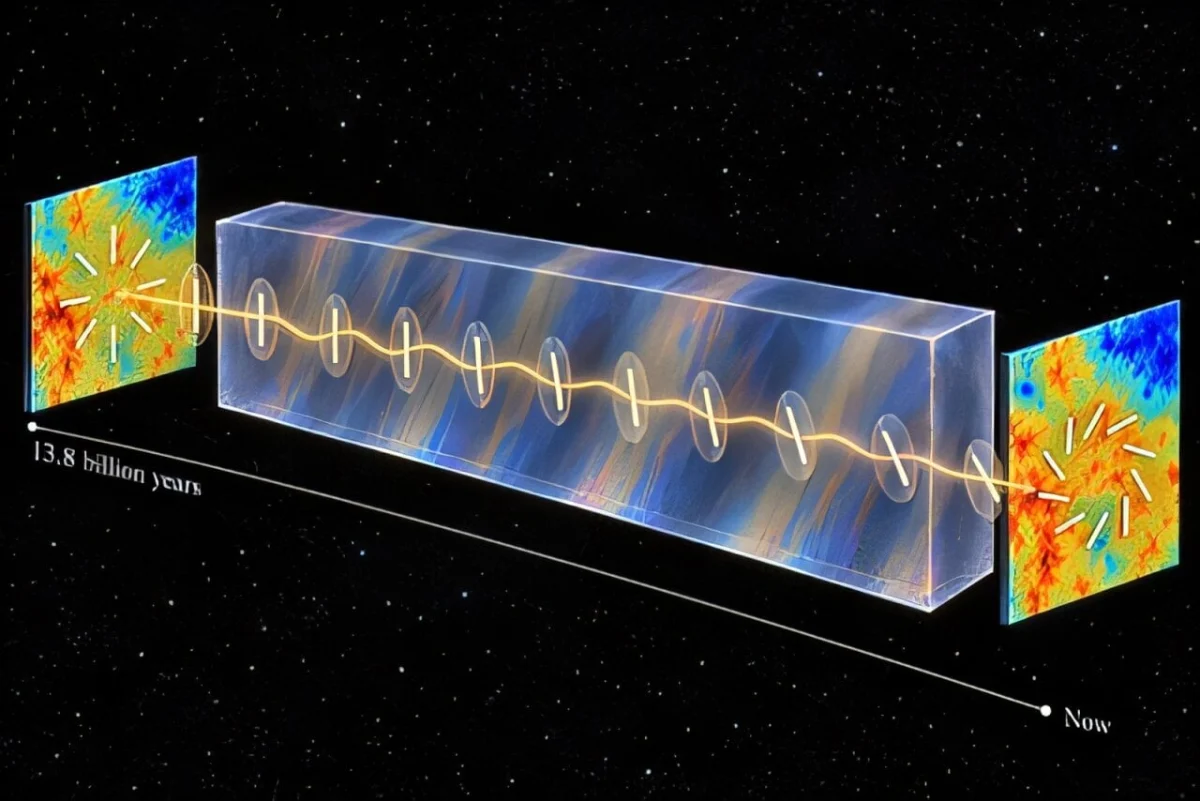
The universe is perpetually bathed in the fossilized remains of its own creation, a sea of ancient photons that have traveled for more than 13 billion years to reach the detectors of modern astronomers. This relic radiation, known as the cosmic microwave background (CMB), serves as the most comprehensive blueprint available for understanding the early evolution of the cosmos. As these photons journeyed from the era of recombination—the moment the universe cooled sufficiently to become transparent—they carried with them subtle signatures of the physical conditions present during the universe’s infancy. Among the most significant of these signatures is the polarization of light, a phenomenon that has recently provided evidence suggesting that the Standard Model of Cosmology may be incomplete. New research validating a "twist" in this ancient light, known as cosmic birefringence, hints at the existence of physics beyond our current understanding, potentially involving exotic forms of dark matter or energy.
The Genesis of Cosmic Polarization
To understand the significance of cosmic birefringence, one must first look back to the state of the universe approximately 380,000 years after the Big Bang. At this stage, the cosmos was a hot, dense plasma of protons, electrons, and photons. As the universe expanded and cooled, electrons and protons combined to form neutral hydrogen atoms. This transition, known as recombination, allowed photons to travel freely through space for the first time, effectively making the universe optically transparent.
However, just before these photons began their multi-billion-year journey, they underwent one final interaction: a process called Thomson scattering. When a photon scatters off a free electron, it becomes polarized, meaning its electric field acquires a specific orientation. Initially, these polarizations were distributed randomly across the sky, showing no large-scale preference for any particular direction. However, as these photons traversed the expanding universe, they were influenced by the underlying geometry of spacetime and the distribution of matter, leading to observable patterns that astronomers categorize into two distinct types: E-modes and B-modes.
E-modes, B-modes, and the History of Detection
The study of CMB polarization has evolved through decades of technological advancement and rigorous observation. E-mode polarization, characterized by a gradient-like pattern where polarization vectors appear to radiate outward from or circle around a central point, was the first to be detected. In 2002, the Degree Angular Scale Interferometer (DASI) located at the South Pole provided the first evidence of E-modes. These patterns are primarily caused by temperature fluctuations in the early plasma—regions of varying density that eventually collapsed to form galaxies and clusters. The data from E-mode observations has consistently aligned with the temperature maps provided by the Planck satellite, reinforcing the foundational pillars of the Big Bang theory.
B-mode polarization is significantly more elusive and complex. Unlike E-modes, B-modes possess a "curl" component, resembling a vortex or a twist in the polarization field. There are two primary mechanisms known to generate B-modes. The first is gravitational lensing, where the path of E-mode polarized light is bent by the gravitational pull of massive structures like galaxy clusters. This bending rotates the polarization slightly, converting some E-modes into B-modes. The second, and more profound, source is primordial gravitational waves—ripples in the fabric of spacetime generated during the epoch of inflation, a period of exponential expansion in the first fractions of a second after the Big Bang.
The search for primordial B-modes reached a fever pitch in 2014 when the BICEP2 (Background Imaging of Cosmic Extragalactic Polarization) collaboration announced a landmark detection. However, subsequent analysis revealed that the signal was largely contaminated by interstellar dust within our own Milky Way galaxy, which emits polarized light that can mimic the signature of the early universe. This controversy underscored the extreme difficulty of isolating true cosmological signals from local foreground noise and instrumental biases.
The Emergence of Cosmic Birefringence
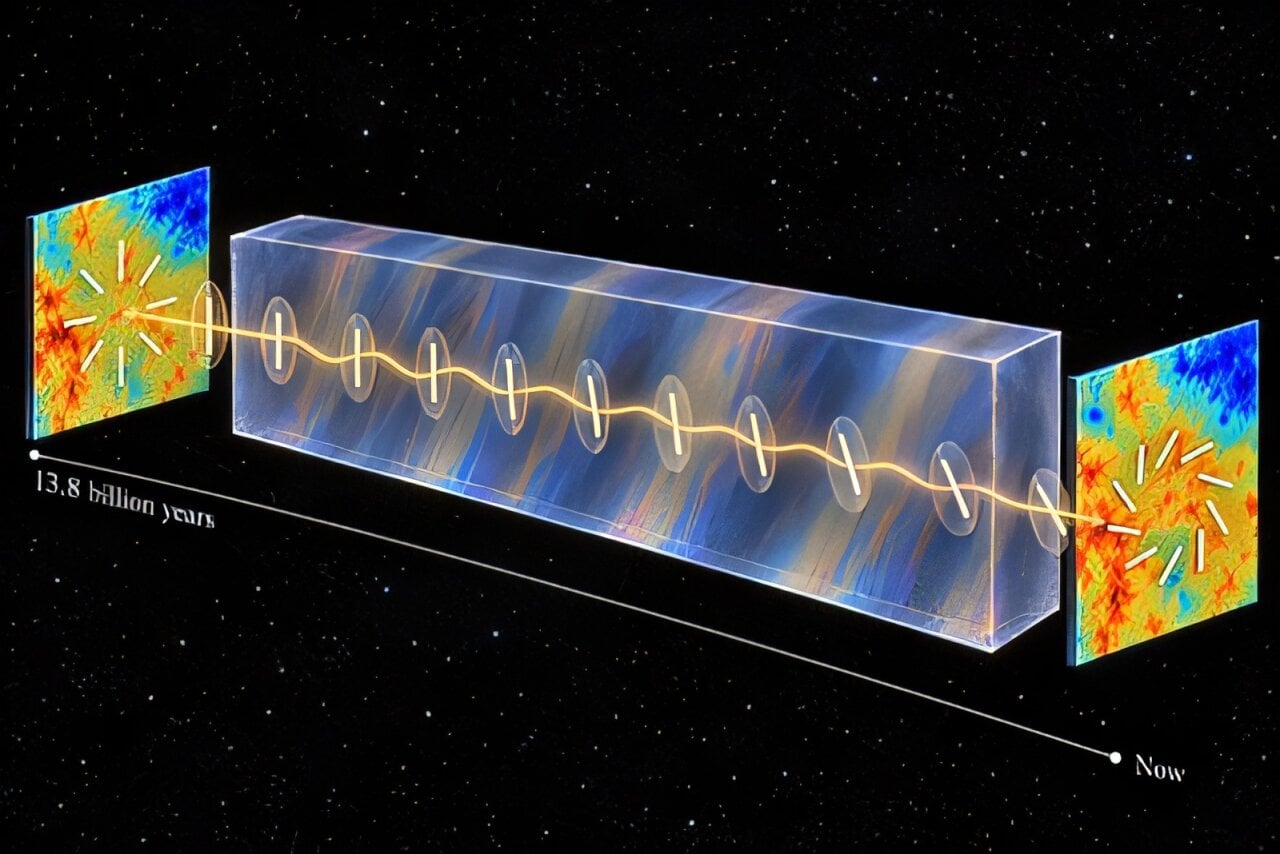
In the Standard Model of Cosmology, it is assumed that the universe is isotropic and homogeneous on a large scale. This implies that there should be no global "twist" or bias in the orientation of polarization across the entire sky. If the universe were perfectly symmetric, any local rotations would average out to zero. However, a phenomenon known as cosmic birefringence—a global rotation of the plane of polarization of CMB photons—would violate this assumption.
Cosmic birefringence is analogous to the way certain crystals or chemical solutions rotate the polarization of light passing through them. In a cosmological context, such a rotation would suggest that the laws of physics might not be perfectly symmetric under parity (mirror-image) transformations. If confirmed, cosmic birefringence would indicate the presence of a "parity-violating" field, possibly linked to dark matter particles such as axions or a dynamic form of dark energy known as quintessence.
The first significant hint of this phenomenon emerged in 2020. Researchers Yuto Minami and Eiichiro Komatsu analyzed data from the Planck satellite and identified a non-zero rotation angle of approximately 0.35 degrees. While the value was small, its statistical significance was enough to challenge the prevailing view that the rotation should be zero. The primary obstacle to accepting this finding was the potential for instrumental bias—the possibility that the rotation was caused by the telescope’s own orientation rather than a property of the universe itself.
Validating the Twist: The 2026 Consistency Test
A recent study led by Anto I. Lonappan, Brian Keating, and Kam Arnold, published in The Astrophysical Journal Letters, has introduced a novel method to distinguish between genuine cosmic birefringence and observational errors. The challenge in previous studies was that the calibration of the telescope’s polarization sensors could inadvertently introduce a rotation angle that looked identical to a cosmological signal.
To solve this, the research team employed a "Differential Polarization Calibration" technique. Rather than treating the entire dataset as a single entity, they divided the Planck 2018 polarization maps into eight distinct observational sets. The logic was straightforward: if the observed rotation were a result of instrumental bias or miscalibration, the value of the rotation would likely vary between different sets or fluctuate based on the specific conditions of the observation. Conversely, if the birefringence were a true property of the cosmos, the rotation angle should remain constant across all independent data subsets.
Upon applying this statistical consistency test, the researchers found that the polarization shift remained remarkably uniform. This consistency strongly suggests that the 0.35-degree rotation is not a byproduct of the Planck satellite’s instrumentation but is instead an intrinsic feature of the light reaching us from the dawn of time. While the study does not claim a "five-sigma" discovery—the gold standard for a confirmed discovery in physics—it significantly bolsters the case that cosmic birefringence is a real physical phenomenon.
Chronology of Key Milestones in CMB Research
The path to discovering cosmic birefringence is marked by several landmark events:
- 1964: Arno Penzias and Robert Wilson discover the CMB, providing the first observational evidence for the Big Bang.
- 1992: The COBE (Cosmic Background Explorer) satellite detects the first temperature fluctuations in the CMB.
- 2002: The DASI interferometer detects E-mode polarization, confirming the role of density fluctuations.
- 2003–2010: The WMAP (Wilkinson Microwave Anisotropy Probe) provides high-resolution maps of the CMB, refining the age and composition of the universe.
- 2013–2018: The Planck satellite mission provides the most detailed polarization and temperature maps to date.
- 2014: BICEP2 announces primordial B-mode detection, later attributed to galactic dust.
- 2020: Minami and Komatsu report a non-zero cosmic birefringence angle using Planck data.
- 2026: Lonappan et al. utilize differential calibration to validate the 2020 findings, reducing the likelihood of instrumental bias.
Theoretical Implications and the Search for New Physics
The confirmation of cosmic birefringence would necessitate a profound revision of the Standard Model of Cosmology (Lambda-CDM). One of the most compelling explanations for this "cosmic twist" involves axions—hypothetical, ultra-light particles that are leading candidates for dark matter. In many theoretical models, an axion field pervading the universe would interact with photons, causing their polarization to rotate as they travel through space.
Another possibility involves "quintessence," a hypothetical form of dark energy that changes over time. Unlike the cosmological constant, which remains static, a quintessence field could interact with electromagnetism in a way that produces parity violation.
The discovery also touches upon the broader "Crisis in Cosmology," a term used by physicists to describe the growing tension between different measurements of the universe’s expansion rate (the Hubble constant). If the Standard Model is failing to account for a global rotation of light, it may also be missing other fundamental components of cosmic evolution.
Future Outlook: The Next Generation of Observatories
While the 2026 study provides a significant confidence boost, the scientific community remains cautious. Confirming a discovery that alters our fundamental understanding of physics requires independent verification from multiple sources.
Future missions are already being prepared to hunt for this signal with even greater precision. The Simons Observatory in Chile and the LiteBIRD satellite mission, led by the Japan Aerospace Exploration Agency (JAXA), are specifically designed to study CMB polarization. These instruments will have the sensitivity required to measure cosmic birefringence with unprecedented accuracy and to potentially detect the primordial B-modes that have eluded scientists for decades.
As observational cosmology enters this new era, the "ancient light" of the CMB continues to be a fertile ground for discovery. If the 0.35-degree twist holds up under the scrutiny of next-generation telescopes, it will mark the beginning of a new chapter in physics—one where the universe is not quite as symmetrical as we once believed, and where the "dark" components of our cosmos finally begin to reveal their true nature.