Clarissa Hana
A sophisticated threat actor, identified as UTA0533, has been actively exploiting two previously undisclosed vulnerabilities in SonicWall’s Secure Mobile Access (SMA) 1000 series appliances for weeks, a campaign that began as early as June 22, 2026, long before the security vendor publicly acknowledged the flaws. The exploitation chain allowed the attackers to gain root access, deploy custom malware, and potentially access sensitive internal network resources. Incident response firm Volexity, which assisted SonicWall in its investigation, detailed the intricate attack vectors and the custom tools employed by the threat actor in a comprehensive report released on July 17, 2026.
The vulnerabilities, now officially designated as CVE-2026-15409, a critical Server-Side Request Forgery (SSRF) flaw, and CVE-2026-15410, a high-severity command injection vulnerability, were chained together to compromise SMA1000 6210, 7210, and 8200v appliances. SonicWall has since released patches, urging customers to apply updates version 12.4.3-03453 and 12.5.0-02835 as a matter of urgency. While the vendor confirmed the zero-day exploitation, the full extent of the compromise and the specific targets remain under active investigation.
Chronology of the Attack Campaign
The timeline of this sophisticated attack campaign, as pieced together by Volexity through log analysis, disk images, and memory forensics, paints a concerning picture of an advanced persistent threat operating undetected for an extended period. The earliest evidence of compromise observed by Volexity dates back to June 22, 2026. This indicates a significant window of opportunity for UTA0533 to establish a foothold within victim networks before any public disclosure or patching efforts.
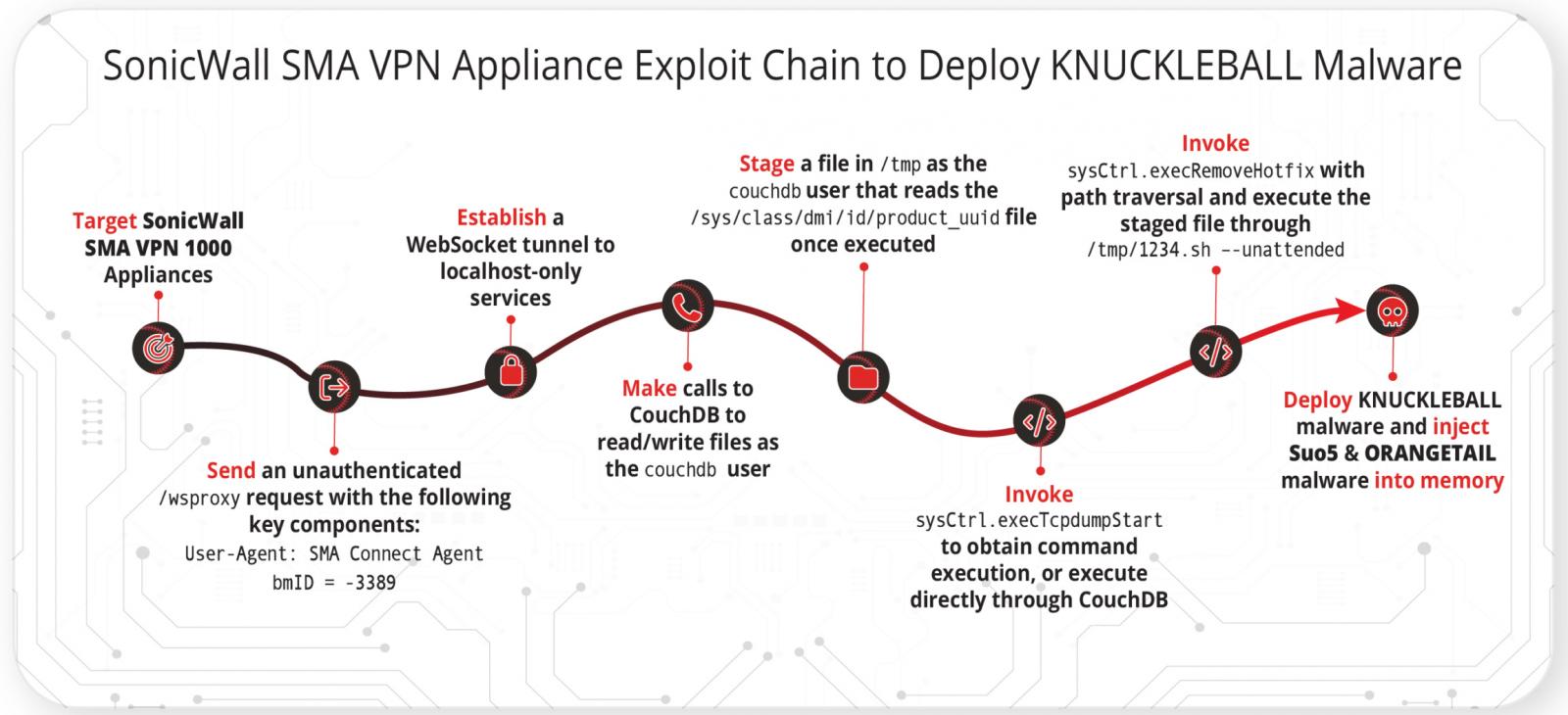
The initial exploitation phase leveraged CVE-2026-15409, a critical SSRF vulnerability. Threat actors utilized this flaw to abuse the SMA1000’s ‘/wsproxy‘ endpoint. This endpoint, when manipulated through the SSRF vulnerability, allowed the attackers to establish unauthenticated WebSocket tunnels. These tunnels provided a direct pathway to internal services that should have been strictly protected and inaccessible from the external internet. Volexity’s analysis specifically noted that this initial access exposed internal applications, including the CouchDB database and the appliance’s own management service.
Following the initial breach, the threat actors moved to the second stage of their operation. They initiated a query against the CouchDB database to extract the appliance’s ‘product_uuid‘. This unique identifier is crucial for the subsequent exploitation of the command injection vulnerability. The precise method by which UTA0533 successfully queried CouchDB remains an area of ongoing investigation, highlighting the multifaceted nature of the attack.

Once the ‘product_uuid‘ was obtained, the attackers proceeded to exploit CVE-2026-15410, the command injection flaw. This was achieved through the Appliance Management Console’s ‘sysCtrl.execRemoveHotfix‘ Remote Procedure Call (RPC) method. This method, when exploited, allowed the threat actors to execute arbitrary commands with root privileges on the compromised SMA1000 appliance. Achieving root access represents a complete compromise of the device, granting attackers the highest level of control.
With full administrative control, UTA0533 proceeded to deploy a custom malware dropper. Volexity has named this dropper KNUCKLEBALL, which was observed being installed under the file name ‘deploy_new.py‘. KNUCKLEBALL served as the initial payload, designed to facilitate the deployment of more advanced malware components.
The final stage of the initial compromise involved KNUCKLEBALL downloading and executing two distinct Java-based malware families: Sou5 and ORANGETAIL. Both of these malware strains were specifically engineered for SonicWall SMA1000 appliances, indicating a targeted and specialized approach by the threat actor.
Technical Deep Dive into the Exploitation Chain and Malware
Volexity’s detailed analysis provides a granular understanding of how UTA0533 operated. The SSRF vulnerability (CVE-2026-15409) was instrumental in bypassing network segmentation and access controls. By exploiting the ‘/wsproxy‘ endpoint, the attackers effectively created a backdoor into the internal network infrastructure that the SMA1000 appliance was protecting. This is a common tactic for threat actors aiming to gain a deeper understanding of a target’s network architecture and identify further vulnerabilities or valuable data.
The successful exfiltration of the ‘product_uuid‘ from CouchDB is a critical step that highlights the attackers’ reconnaissance capabilities. This piece of information likely served as a unique key or identifier necessary to authenticate or target the subsequent command injection exploit, demonstrating a well-researched and meticulously planned attack sequence.
The command injection vulnerability (CVE-2026-15410) was the linchpin for achieving complete system control. The ability to execute commands as root on a network appliance like the SMA1000 is a highly privileged position. It allows for the modification of system configurations, installation of persistent malware, and complete obfuscation of the attacker’s presence.

KNUCKLEBALL, the dropper, is a crucial element in the malware deployment process. Its role is to act as an intermediary, fetching and executing the more complex Java malware. The use of a Python script for the dropper suggests familiarity with scripting languages commonly used for system administration and automation.
Sou5, one of the primary Java-based malware families, functions as a sophisticated reverse proxy. This allows UTA0533 to tunnel network traffic through the compromised SMA1000 appliance. This capability is vital for maintaining persistent, covert access to internal network resources. By routing traffic through the victim’s own trusted VPN appliance, the attackers can significantly reduce the chances of their malicious activity being detected by network security monitoring systems. It also allows them to access internal systems that would otherwise be unreachable from their own infrastructure.
The second Java-based malware, ORANGETAIL, is described as a custom Java webshell. This type of malware provides attackers with a command-and-control interface, allowing them to send encrypted Java payloads to the compromised appliance. These payloads can then be dynamically executed within an active HTTP session, offering a flexible and powerful mechanism for remote administration and data exfiltration. The use of encrypted payloads adds another layer of obfuscation, making it more challenging for security analysts to understand the nature of the commands being executed.
Further analysis by Volexity revealed that UTA0533 also modified the appliance’s nginx configuration. This modification was specifically to expose the ORANGETAIL webshell remotely, likely to facilitate easier and more direct access for the attackers. In addition, the threat actor installed ROOTRUN, a privilege-escalation tool. ROOTRUN’s function is to ensure that commands can be consistently executed with root privileges, reinforcing the attacker’s persistent control over the compromised system.
SonicWall’s Response and Industry Implications
Upon discovering the exploitation, SonicWall acted swiftly to develop and release patches for the affected SMA1000 appliances. The company issued a stern warning to its customers, emphasizing the critical nature of the vulnerabilities and urging immediate application of the updates. "We are aware that threat actors are actively exploiting two previously undisclosed vulnerabilities in an exploit chain affecting SMA1000 Secure Mobile Access appliances," SonicWall stated in an earlier advisory. "We urge customers to install the available patches immediately."
The fact that these vulnerabilities were exploited as zero-days for an extended period before disclosure underscores a persistent challenge in cybersecurity: the continuous cat-and-mouse game between defenders and sophisticated threat actors. Zero-day exploits, by their very nature, bypass existing security controls and signatures, making them particularly dangerous. The duration of the exploitation before detection suggests a high degree of stealth employed by UTA0533.
The implications of such attacks are far-reaching for organizations relying on VPN solutions for secure remote access. SMA appliances are often deployed at the perimeter of a network, acting as the first line of defense for remote workers and external access. A compromise of these devices can grant attackers direct access to sensitive internal systems, intellectual property, and confidential data.
Broader Impact and Analysis
While Volexity noted that the campaign and malware demonstrated "significant" technical sophistication, the threat actor was "less successful at spreading into victims’ internal networks." This observation suggests that while UTA0533 was adept at compromising the SMA appliances themselves, their ability to pivot and move laterally within the compromised internal networks might have been hindered by other security controls or the limited scope of their immediate objectives. This could indicate a focus on exploiting the VPN appliance itself for reconnaissance, maintaining a persistent presence, or using it as a launchpad for highly targeted attacks rather than a broad, opportunistic network intrusion.
The reliance on custom malware specifically designed for SonicWall SMA1000 appliances points to a highly specialized threat actor. This level of customization suggests that UTA0533 may be a state-sponsored group or a well-funded cybercriminal organization with specific objectives related to the types of data or access that SonicWall SMA appliances typically provide. The group’s ability to discover and weaponize zero-day vulnerabilities indicates a significant investment in research and development.
The incident highlights the critical importance of a multi-layered security approach. While patching vulnerabilities is fundamental, organizations also need robust detection and response capabilities to identify and mitigate threats that bypass initial defenses. This includes continuous network monitoring, endpoint detection and response (EDR) solutions, and regular security audits. Furthermore, the incident underscores the need for vendors to maintain transparent and rapid communication channels with their customer base regarding emerging threats and vulnerabilities.
The prolonged period of exploitation before public disclosure raises questions about the effectiveness of existing threat intelligence sharing mechanisms and the potential for early detection. Organizations that experienced this compromise may face significant challenges in fully eradicating the threat, as sophisticated malware can be deeply embedded within systems, and remnants of attacker activity can be difficult to trace. Forensic investigations, like the one conducted by Volexity, are crucial for understanding the full scope of the compromise and ensuring thorough remediation.
In conclusion, the SonicWall SMA1000 zero-day exploitation campaign serves as a stark reminder of the evolving threat landscape. The sophistication of the attack, the extended period of undetected exploitation, and the deployment of custom malware underscore the need for continuous vigilance, proactive security measures, and rapid response capabilities from both vendors and their customers. The identification of UTA0533 and its modus operandi provides valuable intelligence for the cybersecurity community, enabling enhanced defenses against future similar attacks.