admin
admin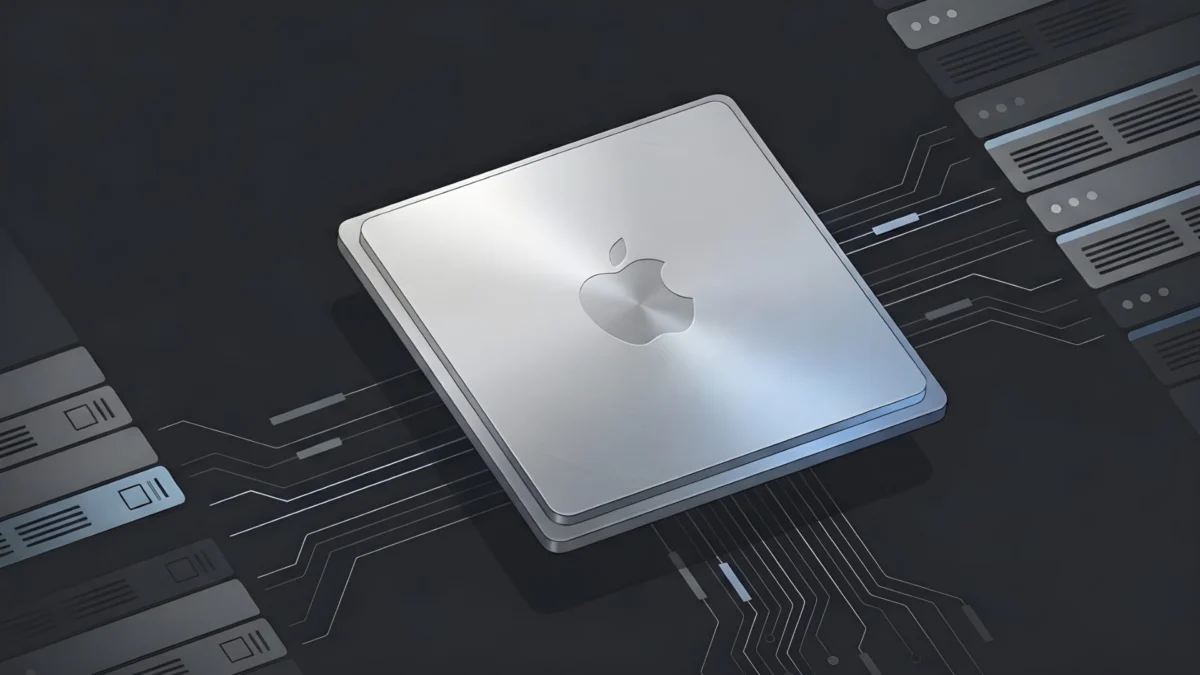
Apple is reportedly undertaking a strategic pivot in its hardware division by developing a high-performance Artificial Intelligence (AI) server chip, internally codenamed "Baltra," designed to integrate seamlessly with NVIDIA’s proprietary NVLink interconnect technology. This move, reported by industry insiders and corroborated by supply chain signals, suggests that Apple is not only seeking to bolster its own "Private Cloud Compute" infrastructure but is also eyeing a return to the enterprise server market—a sector the company famously exited in 2011 following the discontinuation of the Xserve line. By pairing its custom-designed silicon with NVIDIA’s industry-standard networking solutions, Apple aims to achieve a level of interoperability that could make its hardware a viable choice for high-scale data centers and enterprise AI applications.
The Baltra ASIC and the Broadcom Partnership
Central to Apple’s AI ambitions is the "Baltra" Application-Specific Integrated Circuit (ASIC). Unlike general-purpose processors, an ASIC is tailored for specific tasks—in this case, the high-throughput demands of generative AI and large language model (LLM) inference. Apple has reportedly committed an estimated $30 billion to Broadcom to facilitate the development of this chip, alongside other wireless and radio-frequency components. This collaboration underscores Apple’s reliance on Broadcom’s expertise in complex system-on-a-chip (SoC) design, particularly in the realm of high-speed data transfer and AI acceleration.
The Baltra chip is expected to be manufactured using TSMC’s cutting-edge 3-nanometer "N3E" process. This node offers significant improvements in power efficiency and transistor density over previous generations, which is critical for servers that must run 24/7 under heavy computational loads. Furthermore, the architecture is rumored to utilize a chiplet-based design. In a chiplet arrangement, various components of the processor—such as the compute cores, memory controllers, and I/O interfaces—are manufactured as separate pieces and then integrated into a single package.
Apple’s approach to the Baltra project is notably siloed. While Broadcom assists with the design of individual chiplets, Apple reportedly retains control over the final assembly and the high-level architecture. This methodology allows Apple to protect its intellectual property and maintain secrecy regarding the chip’s internal logic, even from its primary development partners. This level of vertical integration is a hallmark of Apple’s silicon strategy, which began with the A-series chips for iPhone and evolved into the M-series for the Mac.
Strategic Integration with NVIDIA’s NVLink
The most significant technical revelation regarding the Baltra project is Apple’s reported decision to support NVIDIA’s NVLink connectivity. NVLink is a high-speed, low-latency point-to-point link used for communication between GPUs and other processors. It is a cornerstone of NVIDIA’s dominance in the AI space, as it allows multiple XPUs (Accelerated Processing Units) to function as a single, massive compute node.
By incorporating NVLink support, Apple is effectively ensuring that its Baltra-based servers can plug into existing NVIDIA-centric data center environments. This "fusion connectivity" provides Apple with immense optionality. It allows the company to use its own chips for specific inference tasks while maintaining the ability to offload or coordinate workloads with NVIDIA’s H100 or B200 Blackwell GPUs. For enterprise customers, this interoperability reduces the friction of adopting Apple hardware, as it eliminates the "silo" effect that often plagues proprietary hardware ecosystems.
A Return to the Enterprise Server Market
Apple’s potential re-entry into the server market marks a dramatic shift in corporate strategy. Since the discontinuation of the Xserve in early 2011, Apple has focused almost exclusively on consumer-facing devices and services. The Xserve was a 1U rack-mounted server that catered to creative professionals and small-to-medium businesses, but it struggled to find a foothold in the broader enterprise market dominated by Dell, HP, and IBM.
The landscape in 2025 is vastly different. The explosion of AI has created an insatiable demand for specialized server hardware. Apple’s proposed servers, reportedly powered by a future "M8" chip variant, would be designed specifically for the AI era. These servers would likely be marketed to enterprises that require high-security AI processing, leveraging Apple’s reputation for privacy and its "Private Cloud Compute" (PCC) protocols.
Industry analysts suggest that by offering an M8-based server with NVLink support, Apple could target a premium segment of the market: companies that want the efficiency of Apple’s ARM-based silicon but need the scale and networking capabilities of a modern AI data center.
Manufacturing and Supply Chain Chronology
The production of these AI servers involves a complex web of global partners. While Apple designs the silicon, the physical assembly of the servers is expected to be handled by Foxconn, Apple’s long-standing manufacturing partner. To navigate the complexities of server rack design and thermal management, Foxconn is reportedly receiving assistance from Lenovo and its specialized subsidiaries.

The timeline for this development reflects Apple’s accelerated push into AI:
- 2020-2023: Apple completes the transition to Apple Silicon across its consumer line, proving the viability of its ARM-based architecture for high-performance tasks.
- Early 2024: Reports emerge of Apple’s $30 billion commitment to Broadcom for AI-specific ASICs and RF components.
- Mid-2024: Apple announces "Apple Intelligence" and the concept of Private Cloud Compute, highlighting the need for secure, cloud-side AI processing.
- Late 2024: Initial reports of the "Baltra" chip surface, identifying the use of TSMC’s 3nm process.
- Present: Revelations regarding NVLink support and the potential for enterprise-grade M8 servers suggest a launch window potentially aligned with the next generation of Apple’s pro-grade silicon.
Private Cloud Compute and User Privacy
A primary driver for Apple’s investment in server hardware is the "Private Cloud Compute" (PCC) architecture. Apple Intelligence functions through an "orchestrator" that resides on the user’s device. When a user makes a Siri query or requests an AI task, the orchestrator determines if the task can be handled locally by the on-device NPU (Neural Processing Unit). If the task requires more compute power, it is sent to the cloud.
Apple’s PCC is designed to ensure that user data is never stored or accessible to Apple. The cloud infrastructure currently utilizes a combination of:
- Custom Apple Silicon: Likely earlier versions of M-series chips repurposed for server use.
- NVIDIA GPUs: Used for heavy lifting in model inference, protected by encrypted protocols.
- Intel CPUs with TDX: Providing Trust Domain Extensions for hardware-isolated virtual machines.
- Google Titan Chips: Ensuring a secure boot process and hardware-level root of trust.
The introduction of Baltra and M8-based servers would allow Apple to replace third-party components with its own silicon, further tightening the security loop and optimizing performance for its specific AI models.
Data and Market Implications
The financial and operational scale of this move is substantial. Apple’s $600 billion commitment to American manufacturing and technological investment includes a significant portion dedicated to data center infrastructure. By developing its own AI ASICs, Apple can significantly reduce its capital expenditure (CapEx) in the long run. While the initial R&D and manufacturing costs are high, custom ASICs are generally more power-efficient and cost-effective than general-purpose GPUs for specific inference workloads.
From a market perspective, Apple is positioning itself against the "hyperscalers"—Amazon Web Services (AWS), Microsoft Azure, and Google Cloud. While those companies offer general-purpose AI compute, Apple is offering a "privacy-first" vertical stack. If Apple opens its M8 servers to enterprise customers, it could capture a significant portion of the "Sovereign AI" market—entities that require high-performance AI but are wary of the data privacy implications of public clouds.
Fact-Based Analysis of Broader Impacts
The decision to adopt NVLink is a pragmatic admission by Apple that NVIDIA’s ecosystem is the "gravity" of the AI industry. Even a company as vertically integrated as Apple recognizes that total isolation is a liability in the data center.
Technological Impact: The use of TSMC’s N3E process for a server-grade chiplet design indicates that Apple is pushing the boundaries of what is possible with ARM architecture in the data center. This could force competitors like Marvell and NVIDIA (with its Grace CPUs) to accelerate their own roadmaps.
Economic Impact: The partnership with Broadcom and Foxconn reinforces the "China Plus One" strategy, as Apple looks to diversify its manufacturing while maintaining deep ties with its primary assemblers. The involvement of Lenovo suggests a collaborative approach to entering the server market, leveraging Lenovo’s existing enterprise sales channels and logistics.
Strategic Impact: Apple is no longer just a device company; it is becoming an infrastructure company. By controlling the silicon in the pocket and the silicon in the server rack, Apple creates a closed-loop ecosystem that is nearly impossible for competitors to replicate. The "Baltra" ASIC is the bridge that connects the consumer experience of Apple Intelligence with the industrial-scale power of the modern data center.
As the industry awaits official confirmation during future hardware events, the trajectory is clear: Apple is building a formidable AI backbone that combines its proprietary silicon prowess with the industry-standard connectivity of NVIDIA, signaling a bold return to the enterprise hardware stage.