Sisilia Frederika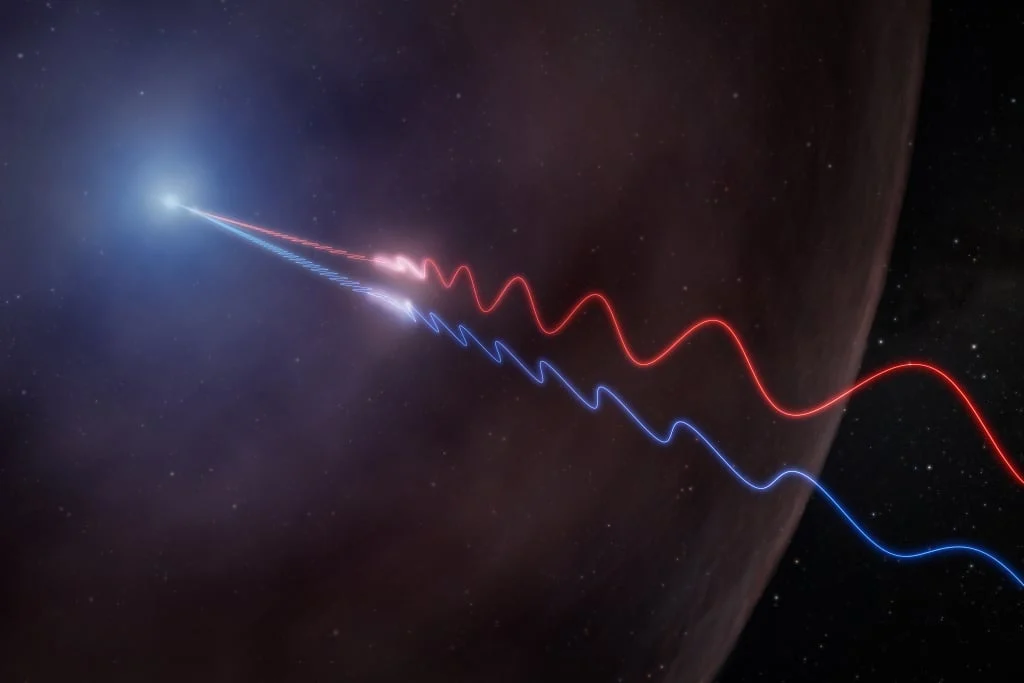
On March 10, 2026, the global astronomical community was alerted to a significant celestial event when the Fermi Gamma-ray Space Telescope detected a long-duration gamma-ray burst, designated GRB 260310A. This high-energy explosion, originating from the cataclysmic death of a massive star billions of light-years away, has since become a landmark case study in high-energy astrophysics. The event occurred within a dense, highly magnetized cloud of ionized hydrogen gas, known as an HII region, which provided a unique laboratory for studying the interaction between relativistic outflows and their surrounding environments. Following the initial detection, a coordinated multi-wavelength observation campaign was launched, involving ground-based and space-borne assets, including the National Science Foundation’s (NSF) Karl Jansky Very Large Array (VLA) in New Mexico.
The VLA’s subsequent detection of polarized radio waves from the event marked a historic milestone: the first-ever observation of Faraday rotation within a gamma-ray burst (GRB). This phenomenon, where the orientation of polarized light twists as it traverses a magnetized plasma, has long been sought in the study of GRBs but had remained elusive until now. The findings, recently detailed in a study led by researchers from the University of Utah and other global institutions, provide unprecedented insights into the magnetic field structures that power the most energetic explosions in the known universe.
The Chronology of GRB 260310A
The detection of GRB 260310A followed a sequence of events that highlights the efficiency of modern "time-domain" astronomy. At 02:27:53 UTC on March 10, 2026, the Fermi Gamma-ray Burst Monitor (GBM) triggered on a bright, long-duration pulse of gamma radiation. Within seconds, automated alerts were broadcast to observatories worldwide. Long-duration GRBs—those lasting more than two seconds—are typically associated with the "collapsar" model, in which the core of a massive star collapses into a black hole or a neutron star, triggering a supernova and launching powerful jets of plasma at nearly the speed of light.
Following the Fermi alert, the Swift Observatory’s X-ray Telescope (XRT) and various optical telescopes localized the source to a distant galaxy. As the high-energy gamma rays and X-rays began to fade, the "afterglow"—produced by the jet’s collision with the surrounding interstellar medium—became visible at longer wavelengths. By late March and into April 2026, the VLA was directed toward the coordinates of the burst. Unlike previous attempts to measure polarization in GRBs, which often focused on the immediate moments following the explosion at millimeter wavelengths, the VLA team opted for a sustained monitoring approach in the centimeter bands. This strategy allowed them to capture the signal as it passed through the dense, magnetized environment of the progenitor star’s birth cloud.
Understanding Faraday Rotation in Cosmic Extremes
To appreciate the significance of this discovery, one must understand the mechanics of light polarization and Faraday rotation. Light is composed of oscillating electromagnetic fields; when these oscillations occur in a specific orientation, the light is said to be polarized. In the context of a GRB, polarization is generated by synchrotron radiation—the process by which electrons spiraling around magnetic field lines at relativistic speeds emit light.
Faraday rotation occurs when this polarized light travels through a medium containing both a magnetic field and free electrons (a magnetized plasma). As the wave moves through the plasma, the plane of polarization rotates. The degree of this rotation is dependent on the wavelength of the light and the "Rotation Measure" (RM), which is a function of the magnetic field strength and the density of the electrons along the line of sight.
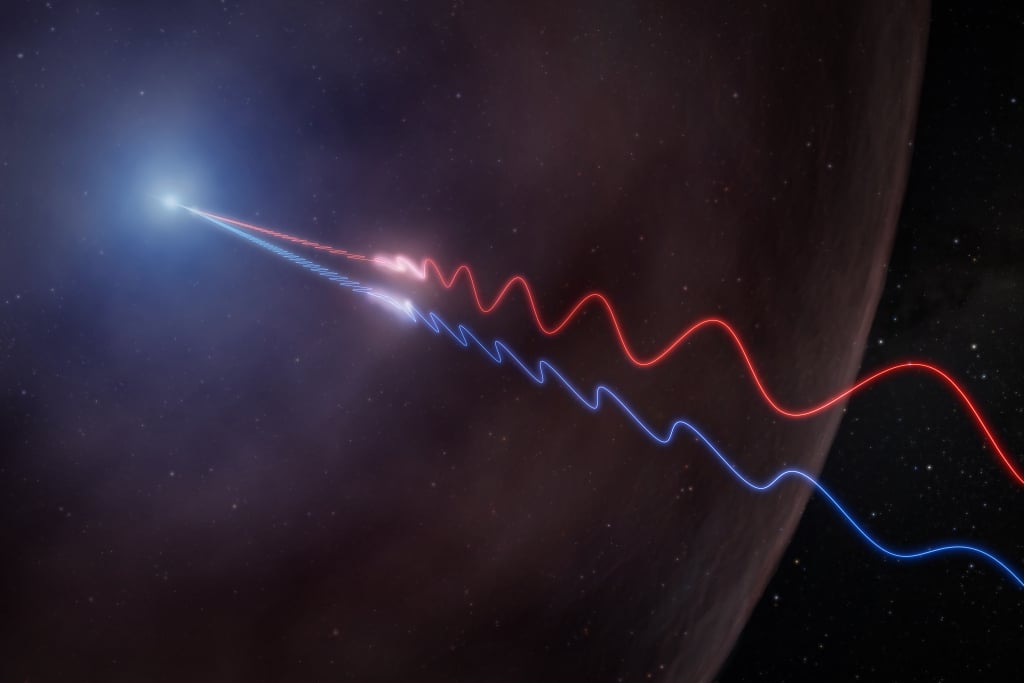
Prior to GRB 260310A, Faraday rotation had been observed in various galactic and extragalactic sources, such as pulsars and active galactic nuclei (AGN), but never in the afterglow of a GRB. The VLA data revealed that the polarization angle shifted significantly across different radio frequencies. This "frequency-dependent twist" served as a "magnetic fingerprint," allowing scientists to calculate the strength and orientation of the magnetic field surrounding the site of the explosion.
Technical Insights and Data Analysis
The data gathered by the VLA provided a stark contrast to previous observations. Traditionally, searches for GRB polarization were conducted using facilities like the Atacama Large Millimeter/submillimeter Array (ALMA). While ALMA is exceptionally sensitive, it operates at shorter wavelengths where Faraday rotation is much less pronounced. By shifting the focus to the centimeter bands provided by the VLA, the research team was able to detect a rotation measure that would have been invisible at higher frequencies.
Analysis of the VLA observations indicated that the magnetic field along the path of the light was thousands of times stronger than the average magnetic field found in the interstellar medium of the Milky Way. This suggests that the light was not merely passing through generic galactic space, but was interacting with the intense, localized magnetic environment of the HII region where the progenitor star lived and died.
Tanmoy Laskar, a professor at the University of Utah and a key member of the observation team, emphasized the rarity of this data. "GRBs are the most powerful explosions in the Universe, and magnetic fields are thought to play a central role in powering them, but probing those fields has been extraordinarily difficult," Laskar stated. "By detecting polarized radio emission, we can now directly measure the magnetic environment of one of the Universe’s most violent events. Our new GRB observations allow us to use the Universe as our laboratory to test our understanding of how physics operates in such extreme conditions."
The Progenitor Environment: HII Regions and Massive Stars
The discovery provides strong empirical support for the current consensus regarding the origins of long-duration GRBs. The fact that GRB 260310A occurred within an HII region—a bubble of ionized hydrogen created by the intense ultraviolet radiation and stellar winds of young, massive stars—confirms that the burst originated from a stellar "heavyweight."
These HII regions are often found in the spiral arms of galaxies, where star formation is most active. Massive stars have short lifespans, often only a few million years, meaning they do not have time to drift far from their birthplaces before exploding as supernovae. The dense, magnetized plasma of the HII region acts as a medium that imprints the Faraday rotation onto the GRB’s light. This environmental context is crucial for scientists attempting to model the life cycles of the universe’s first generations of stars, which are thought to have been similarly massive and lived in high-density environments.
Expert Reactions and Future Implications
The lead author of the study, Collin Christy, a graduate student who spearheaded the observation team, highlighted the technological leap represented by this detection. "Previous searches for polarization in GRBs used facilities that measure shorter wavelengths and had to happen early, before the afterglow light faded," Christy explained. "Now, with the NSF VLA, we’ve pushed into the centimeter bands and made the first ever measurement of Faraday rotation in a GRB. Each new observation reveals another layer of the magnetic story these explosions are telling us."
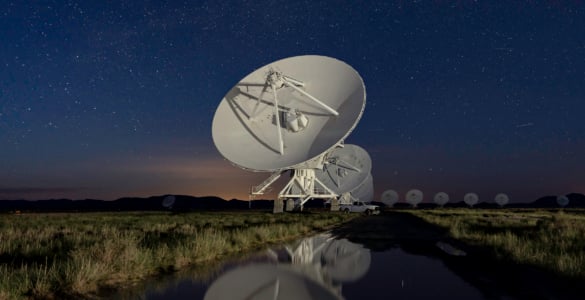
The broader astronomical community views this as a "proof of concept" for future studies. Dr. Kate Denham Alexander, an assistant professor and Christy’s PhD advisor, noted that this discovery opens a new window into relativistic physics. "Future monitoring of GRB afterglows with the NSF VLA and other radio telescopes will allow scientists to watch magnetic field structures evolve in real time," Alexander said. "This is a capability that could transform our understanding of how relativistic jets form, how they are powered, and how magnetic energy is released in the most extreme environments the Universe has to offer."
Historical Context: From Mystery to Measurement
The study of gamma-ray bursts has undergone a radical transformation since they were first discovered in the late 1960s by the Vela satellites, which were designed to monitor for clandestine nuclear tests. For decades, GRBs were mysterious flashes of light that appeared randomly in the sky, leaving no trace. It was not until the 1990s, with the launch of the BeppoSAX satellite, that astronomers were able to detect the "afterglows" that allowed for the localization of these events to distant galaxies.
The detection of Faraday rotation in GRB 260310A represents the next step in this evolution. We have moved from simply detecting these events to "dissecting" them. By analyzing the polarization and its rotation, astronomers are no longer just looking at the light; they are using that light as a probe to map the invisible magnetic scaffolding of the distant universe.
Broader Impact on Astrophysics
The implications of this discovery extend beyond the study of GRBs. Magnetic fields are one of the most important yet least understood components of the cosmos. They influence everything from the formation of stars and planets to the evolution of entire galaxies. However, measuring magnetic fields at cosmological distances is notoriously difficult.
The technique demonstrated with GRB 260310A provides a new tool for "cosmic magnetometry." By observing Faraday rotation in GRBs at various distances, astronomers can begin to map the evolution of magnetic fields throughout cosmic time. This could help answer fundamental questions about whether magnetic fields were present in the early universe or if they were generated later by the first generations of stars and galaxies.
Furthermore, the data helps refine the "Standard Model" of GRBs. Scientists can now better constrain the "Lorentz factor"—the speed at which the jet is traveling—and the total energy budget of the explosion. If the magnetic field is as strong as the VLA data suggests, it implies that magnetic reconnection (a process where magnetic field lines snap and realign, releasing vast amounts of energy) may be the primary engine driving the jet’s acceleration.
As telescopes like the Next-Generation Very Large Array (ngVLA) and the Square Kilometre Array (SKA) come online in the next decade, the frequency of such detections is expected to increase. GRB 260310A has set the stage for a new era of "polarimetric" astronomy, where the twist of a light wave can reveal the secrets of a star’s violent end and the magnetic invisible forces that shape our universe.