Sisilia Frederika
The long-standing scientific consensus regarding the geological state of Mars has undergone a fundamental transformation following the analysis of seismic data collected by NASA’s InSight lander. For decades, the Red Planet was categorized as a "geologically dead" world, a silent sentinel of the solar system whose volcanic and tectonic glory days ended billions of years ago. Unlike Earth, which is characterized by a dynamic mosaic of shifting tectonic plates, Mars is a "stagnant lid" planet, possessing a single, continuous outer crust. This structural rigidity led researchers to believe that internal activity had long since ceased as the planet’s core cooled. However, a landmark study published in Nature Communications by an international team of researchers from Imperial College London, Columbia University, and the University of Illinois Urbana-Champaign has provided definitive proof that the Martian interior remains restless. By isolating and modeling a specific seismic event, designated S0976a, scientists have confirmed that the Valles Marineris—the largest canyon system in the solar system—is tectonically active today.
The Paradigm Shift: From Stagnant Lid to Active Interior
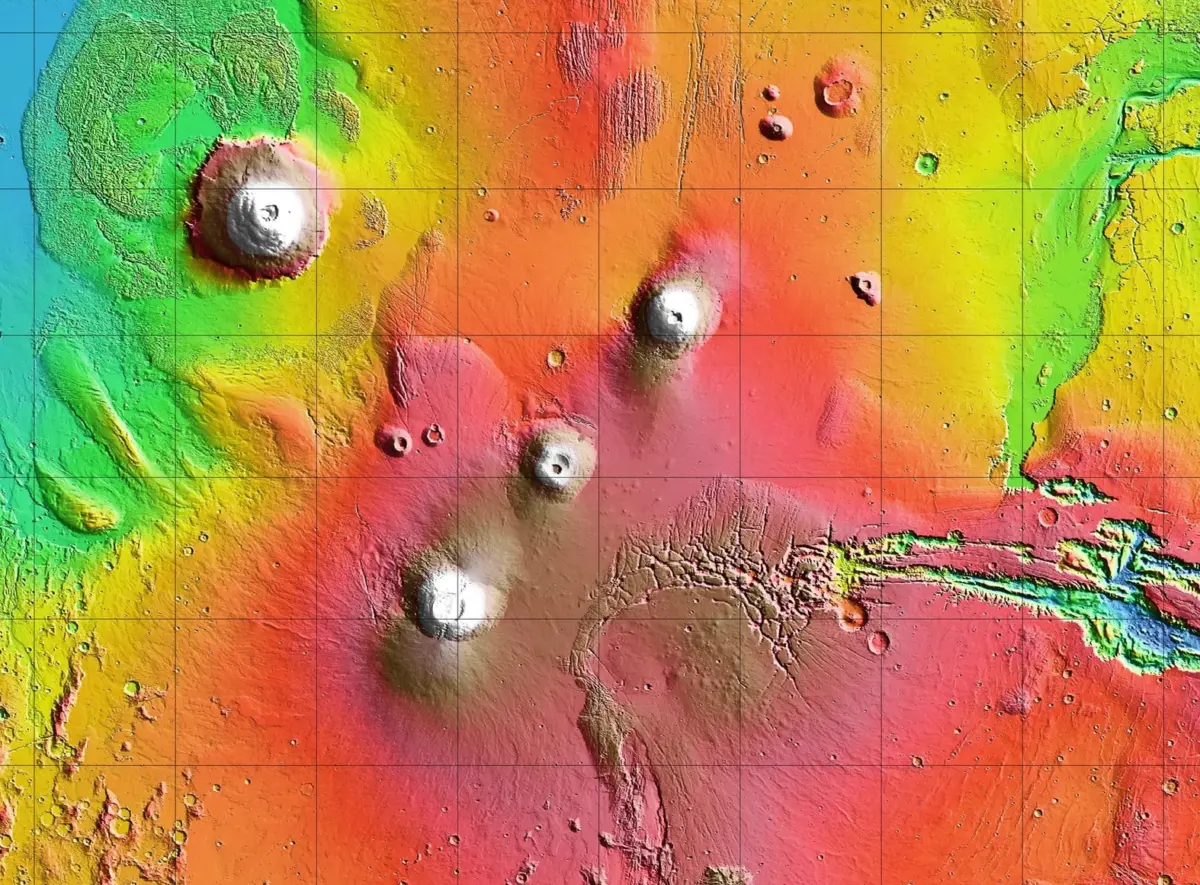
The classification of Mars as a stagnant lid planet was based on the observation that it lacks the subduction zones and mid-ocean ridges that drive geological renewal on Earth. On our planet, plate tectonics act as a cooling mechanism, recycling the crust and releasing internal heat. On Mars, the absence of these plates suggested that heat could only escape through conduction or isolated volcanic "hotspots" that had likely gone cold. While the Martian surface is scarred by massive volcanoes like Olympus Mons and the sprawling chasms of Valles Marineris, these were largely viewed as ancient relics of the Noachian and Hesperian periods, dating back some three to four billion years.
The arrival of NASA’s Interior Exploration using Seismic Investigations, Geodesy and Heat Transport (InSight) lander in November 2018 marked a turning point in planetary science. Equipped with the Seismic Experiment for Interior Structure (SEIS), a hyper-sensitive seismometer, InSight was designed to listen for the "pulse" of Mars. Over its four-year mission, the lander recorded over 1,300 marsquakes. While many were attributed to meteoroid impacts or thermal contraction of the crust, a subset of these events suggested deep-seated tectonic origins. The discovery of activity beneath Valles Marineris represents the most significant evidence to date that the planet’s most iconic geological features are still evolving.
Valles Marineris: A Geological Giant in Motion
To understand the significance of the recent findings, one must consider the sheer scale of Valles Marineris. Extending across nearly a quarter of the Martian circumference, the canyon system is approximately 3,900 kilometers (2,423 miles) long, up to 600 kilometers (373 miles) wide, and plunges to depths exceeding 9 kilometers (5.5 miles). By comparison, Earth’s largest canyon system, the Yarlung Tsangpo Grand Canyon in Tibet, is roughly 505 kilometers long and reaches a maximum depth of 6 kilometers. Even the famous Grand Canyon in the United States is dwarfed, being only 446 kilometers long and less than 2 kilometers deep.
The formation of Valles Marineris is traditionally linked to the Tharsis Bulge, a massive volcanic plateau located to its west. As the Tharsis region grew under the weight of accumulating lava flows billions of years ago, the Martian crust was subjected to immense tensional stress. This caused the crust to crack and pull apart, creating a series of rift faults. While erosion and landslides subsequently widened the canyon, the underlying framework remained a network of ancient faults. The new research led by Assistant Professor Jung-Hun Song of Imperial College London indicates that these faults, despite their age, remain unstable and capable of rupturing under modern-day stresses.

Analysis of the S0976a Seismic Event
The focal point of the study was the S0976a event, a significant marsquake recorded by InSight on August 25, 2021. This event was unique for several reasons. First, it was the only major marsquake detected in the planet’s western hemisphere, originating on the opposite side of the planet from the lander’s position in Elysium Planitia. Because the seismic waves had to travel a vast distance through the Martian interior to reach InSight’s sensors, they provided a rare look at the planet’s deep structure.
Initial interpretations of S0976a were varied. Scientists considered whether the vibration was caused by a high-velocity meteoroid impact or a massive landslide within the canyon walls—both common occurrences on Mars. However, the seismic signature of the event did not align with these hypotheses. Impact events typically produce high-frequency waves and leave visible craters, while landslides generate a specific type of low-frequency rumble that tapers off differently.
To resolve the mystery, Professor Song’s team utilized advanced numerical modeling to simulate different types of seismic sources. They compared these models against the actual waveforms recorded by InSight. The results were conclusive: the seismic waves were best explained by a "strike-slip" mechanism. In a strike-slip fault, two blocks of crust slide horizontally past one another. The data indicated that this movement occurred at a depth of 20 to 40 kilometers (12 to 24 miles) beneath the surface of Valles Marineris. This depth is significant because it places the rupture well within the brittle portion of the Martian crust, far below the surface layers affected by weather or superficial mass wasting.
Corroborating Evidence from Orbital Imagery
To ensure the accuracy of their seismic models, the researchers cross-referenced their findings with high-resolution imagery from NASA’s Mars Reconnaissance Orbiter (MRO). The MRO has been orbiting Mars since 2006, providing a continuous visual record of the surface. The team examined images of the western Valles Marineris region taken shortly after the August 2021 quake to look for "fresh" geological changes.
No new impact craters were found, effectively ruling out a meteoroid as the source. Furthermore, while the canyon walls are prone to collapses, there were no new large-scale landslides that coincided with the timing and energy of S0976a. The absence of surface-level changes supported the theory of a deep-seated tectonic rupture. The geological context of the region, characterized by long-lived fault systems that parallel the canyon’s orientation, provided the final piece of the puzzle. The seismic data and the orbital geology were in perfect alignment, pointing toward active horizontal faulting.
Chronology of Discovery and Mission Legacy
The journey to this discovery began on November 26, 2018, when InSight touched down on the smooth plains of Elysium Planitia. For the next two years, the lander established a baseline of Martian "background noise." The first major marsquakes were detected in 2019, primarily originating from the Cerberus Fossae region, a series of semi-parallel fissures.

The S0976a event in late 2021 came at a critical time for the mission. By this point, dust had begun to accumulate on InSight’s solar panels, significantly reducing its power output. Despite these challenges, the lander’s mission was extended, allowing it to capture the Valles Marineris event. InSight officially ceased operations in December 2022 after its power levels dropped below the threshold required for communication. However, as this study demonstrates, the "ghost" of the mission lives on through its data. It often takes years of post-mission analysis to decode the complex signals recorded by planetary probes, and S0976a is proving to be one of the most scientifically lucrative events in the mission’s catalog.
Broader Implications for Planetary Science
The confirmation of active faulting in Valles Marineris has profound implications for our understanding of planetary evolution. It suggests that the "stagnant lid" model may be an oversimplification. While Mars does not have global plate tectonics, it possesses localized tectonic activity driven by the planet’s slow cooling and the resulting contraction of its volume. As the planet cools, the crust shrinks and puts pressure on existing weak points—such as the massive faults of Valles Marineris.
Furthermore, this discovery suggests that other planetary bodies previously dismissed as geologically dead, such as the Moon or even large asteroids, may still harbor internal activity. Dr. Doyeon Kim, a senior author of the study and Assistant Professor at Imperial College London, noted that the waves from S0976a were particularly valuable because they traveled through the Martian core. This allowed the team to investigate not only the source of the quake but also the deep interior density and composition of the planet.
The study also highlights the diversity of Martian tectonics. While the Cerberus Fossae quakes were associated with extensional forces (the crust pulling apart), the S0976a event in Valles Marineris shows strike-slip motion (sideways sliding). This indicates that the stresses within the Martian crust are not uniform but are influenced by local geological structures and regional thermal histories.
Future Exploration and Conclusion
As scientists continue to mine the InSight data archives, the focus will likely shift toward identifying other "active" zones on Mars. The realization that Valles Marineris is still moving adds a new layer of complexity to future human exploration plans. If the region is seismically active, future habitats or infrastructure placed near the canyon would need to be engineered to withstand potential marsquakes.
The findings by Song and his colleagues have effectively rewritten the narrative of Mars. The Red Planet is not merely a graveyard of ancient volcanoes, but a world that continues to creak and groan under the weight of its own evolution. From the depths of the solar system’s largest canyon to the very core of the planet, the S0976a event has provided a window into a dynamic Martian interior that was hidden from view for centuries. As planetary science moves forward, the legacy of InSight will be defined by its ability to prove that even a "stagnant" planet can still hold the fire of geological life.