Sisilia Frederika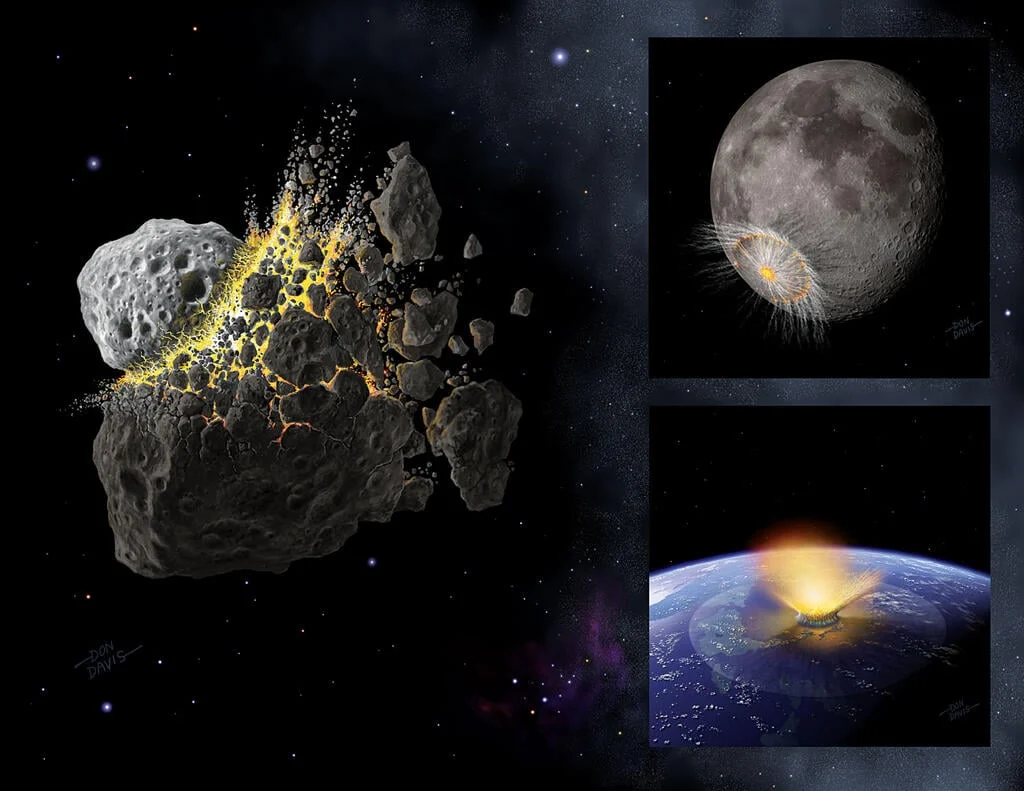
The history of the solar system is often written in the scars of its planetary bodies, yet on Earth, those records are frequently erased by the relentless march of plate tectonics, volcanic activity, and atmospheric erosion. However, new research led by Dr. William F. Bottke of the Southwest Research Institute (SwRI) has turned to our more geologically static neighbor, the Moon, to uncover a violent chapter in cosmic history that occurred approximately 800 million years ago. A study accepted for publication in the Planetary Science Journal suggests that a massive asteroid collision in the main belt triggered a prolonged "impact shower" that significantly altered the environments of Earth, the Moon, Mars, and Venus, potentially influencing the trajectory of life on our home planet.
The catalyst for this celestial upheaval was the catastrophic destruction of the parent body of the Eulalia asteroid family. By analyzing lunar cratering rates and matching them with dynamical models of asteroid movement, the SwRI-led team has proposed a cohesive timeline that links the breakup of a 100-kilometer-wide asteroid to a series of transformative events across the inner solar system. This research not only provides a possible origin for many of the near-Earth asteroids (NEAs) we track today but also offers a provocative explanation for dramatic climatic shifts in Earth’s deep past.
The Breakup of the Eulalia Parent Body
Around 800 million years ago, deep within the asteroid belt between Mars and Jupiter, a massive asteroid roughly the size of a large terrestrial city suffered a high-velocity collision. This parent body, the progenitor of the Eulalia family, was shattered into thousands of fragments. While collisions in the asteroid belt are common over billions of years, the location of this specific event was particularly consequential.
The Eulalia parent body was situated near the 3:1 mean motion resonance with Jupiter. In orbital mechanics, this "J3:1" resonance occurs where an object orbits the Sun exactly three times for every one orbit of Jupiter. This specific region acts as a gravitational "escape hatch." The repeated gravitational tugs from Jupiter increase the eccentricity of any object within the resonance, eventually flinging it into the inner solar system.
According to the study’s dynamical models, the initial collision immediately injected a significant volume of debris into the J3:1 resonance. Over the following 150 million years, additional fragments were gradually nudged into this same gravitational trap through the Yarkovsky effect. This phenomenon occurs when an asteroid absorbs sunlight and re-emits it as heat; the resulting thermal thrust, though minuscule, is enough to alter an asteroid’s orbit over millions of years. This combination of immediate injection and slow migration created a sustained "shower" of impacts across the terrestrial planets.
The Lunar Record as a Cosmic Witness
The Moon serves as the primary evidence locker for this theory. Unlike Earth, the Moon lacks an atmosphere and tectonic activity, preserving impact craters for billions of years. Researchers have long noted a statistical uptick in the formation of large lunar craters around 800 million years ago.
One of the most prominent features associated with this era is the Copernicus crater, a massive 93-kilometer-wide impact site. While Copernicus is a visible testament to this period, the most granular data comes from the Apollo missions. Astronauts returned samples containing tiny glass beads—spherules formed by the intense heat of meteorite impacts. Radiometric dating of these beads has revealed a distinct clustering of ages around the 800-million-year mark, suggesting a period of intense bombardment rather than sporadic, isolated strikes.
Dr. Bottke’s team utilized these lunar datasets to calibrate their models, concluding that the frequency of impacts during this window was significantly higher than the background rate. This "impact flux" likely delivered a total mass of meteoritic material to the Earth-Moon system far exceeding the weight of the asteroid that famously ended the reign of the dinosaurs 66 million years ago.
Earth’s Bitter Springs Anomaly and the Road to Snowball Earth
The implications for Earth are profound. Due to its larger size and stronger gravitational pull, Earth would have experienced approximately 20 times more impacts than the Moon during this period. The timing of this bombardment coincides with the Bitter Springs Anomaly, a major disruption in the global carbon cycle observed in the geological record of the Neoproterozoic Era.
The study posits a speculative but scientifically grounded connection between the Eulalia breakup and Earth’s climate. The influx of asteroid dust—silicate particles and other debris—into the upper atmosphere could have acted as a cooling agent, reflecting solar radiation back into space. This "stratospheric aerosol" effect, combined with the potential for multiple large-scale impacts to trigger volcanic activity or alter ocean chemistry, may have contributed to the cooling trend that eventually led to the "Snowball Earth" glaciations (such as the Sturtian and Marinoan periods).
Biologically, this era was a turning point. The stress of a changing climate and the chemical influx from asteroid impacts may have driven evolutionary diversification. Shortly after this period, the fossil record shows an increase in the complexity of eukaryotes, the precursors to all complex life on Earth. While the researchers emphasize that this connection remains a hypothesis, it provides a new framework for geobiologists to explore the extraterrestrial drivers of terrestrial evolution.
Impact on the Red and Veiled Planets: Mars and Venus
The Eulalia impact shower was not limited to the Earth-Moon system. Mars, being closer to the asteroid belt, would have been a primary target. The researchers pointed to a notable peak in the formation of massive volcanic calderas on Mars approximately 800 million years ago. They suggest that the repeated "pummeling" by large asteroid fragments could have transmitted enough seismic energy through the Martian crust to destabilize underground magma reservoirs, triggering a surge in planetary volcanism.
Venus presents an even more dramatic scenario. The surface of Venus is remarkably young, with an average age of roughly 650 to 750 million years, suggesting a planet-wide "resurfacing" event that erased older craters. The study offers a hypothesis that the tail end of the Eulalia impact shower could have been the trigger. A series of large impacts might have instigated a catastrophic "runaway" volcanic event, where the entire crust was essentially recycled. This would explain why Venus today lacks the ancient cratering record seen on the Moon or Mars.
Modern Remnants: Ryugu and Bennu
The legacy of the Eulalia breakup persists in the modern era. Recent space missions have provided direct evidence of the types of materials involved in this ancient catastrophe. Samples returned from the asteroids Ryugu (by JAXA’s Hayabusa2) and Bennu (by NASA’s OSIRIS-REx) show that these "rubble pile" asteroids are rich in carbonaceous material.
Chemical and isotopic analysis suggests that Ryugu and Bennu are likely fragments of a larger C-type (carbonaceous) asteroid that shattered long ago. The SwRI research aligns with the theory that these near-Earth objects are the "leftovers" of the Eulalia family. By studying these asteroids, scientists are essentially performing a forensic analysis on the debris that nearly reshaped the inner solar system 800 million years ago.
Scientific Significance and Future Inquiry
The study by Dr. Bottke and his colleagues represents a significant step in "collisional and dynamical modeling," a field that seeks to reverse-engineer the history of the solar system through orbital mathematics and geological evidence. By successfully linking the breakup of a specific asteroid family to observed events on multiple planets, the researchers have created a more integrated view of planetary development.
However, the scientific community remains cautious regarding the more speculative links to Earth’s "Snowball" period and Venus’s resurfacing. Critics and peers note that while the timing is suggestive, "extraordinary claims require extraordinary evidence." Proving a direct causal link between asteroid dust and the Bitter Springs Anomaly will require more precise geochemical signatures, such as iridium or osmium enrichment in sedimentary layers from that specific timeframe.
Regardless of the eventual confirmation of these speculative links, the paper underscores a critical reality: the planets of the inner solar system do not exist in isolation. They are part of a dynamic, often violent environment where a single event in the asteroid belt can dictate the climatic and geological future of worlds millions of miles away.
As space agencies continue to monitor near-Earth objects for planetary defense, studies like this serve as a reminder of the sheer power of orbital dynamics. Understanding the Eulalia breakup is not just an exercise in ancient history; it is a vital part of understanding the ongoing processes that protect—or threaten—the stability of our modern world. The search for additional evidence continues, with future lunar missions and deeper geological surveys on Earth expected to provide the next pieces of this 800-million-year-old puzzle.