Vera Intan Clara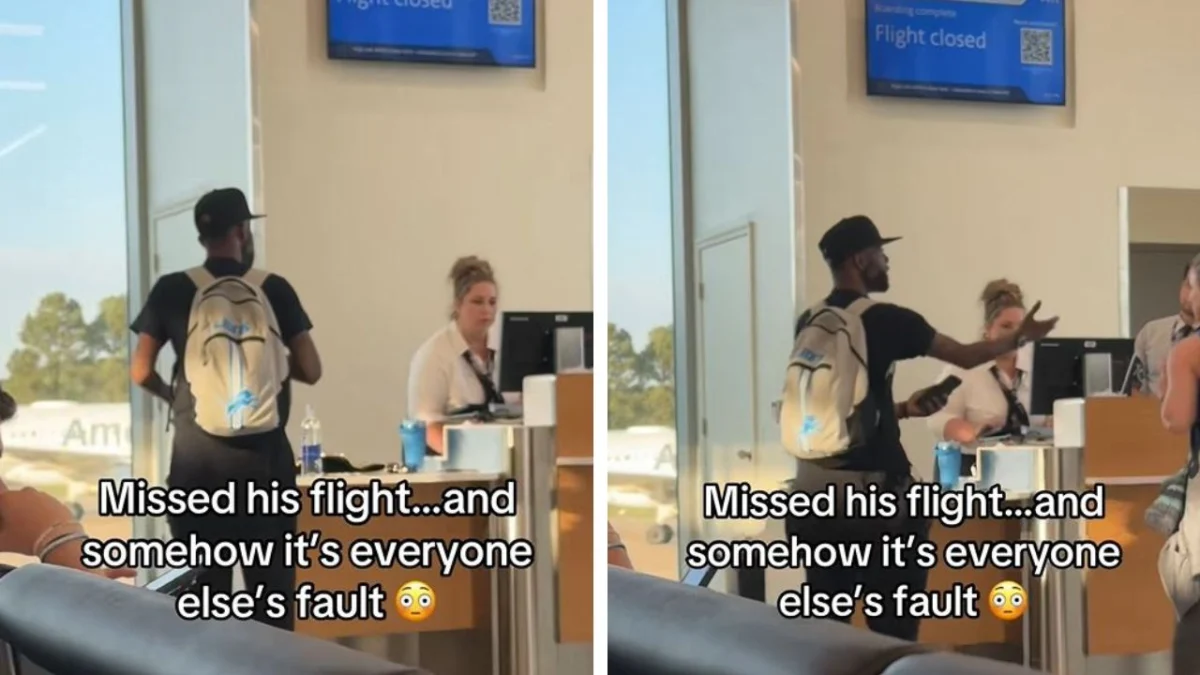
A recent TikTok video, posted by user @bourbonbarry on April 18, 2026, has rapidly gained traction across social media platforms, documenting a tense confrontation between a passenger who missed his flight and an airline employee at the gate. The incident, which unfolded at an undisclosed airport, has sparked widespread discussion regarding passenger accountability, airline protocols, and the often-stressful environment of air travel. As of publication, the video had garnered significant engagement, accumulating 26,100 likes, 1,147 comments, and 1,174 shares, underscoring the public’s keen interest in such everyday travel dramas.
The Incident Unfolds: A Chronology of Missed Departure
The video footage provides a stark visual context to the unfolding dispute. Behind the airline gate desk, a digital monitor prominently displays the message "Flight Closed" for a flight destined for Charlotte, North Carolina. The visible status of the flight serves as an immediate indicator of the passenger’s predicament. Several other passengers and airline staff members are discernible in the background, witnessing the exchange at the now-closed gate.
According to the TikTok creator’s caption, which adopted a direct, second-person address to the passenger, the events leading to the confrontation followed a predictable, yet frustrating, pattern for airline personnel. The caption vividly recounted the standard boarding process: "Boarding starts. They call it once… twice… twenty times. Everyone else gets on the plane." The creator then underscored the passenger’s late arrival, stating, "You stroll up after departure like it’s a dinner reservation." This narrative sets the stage for a conflict rooted in a fundamental misunderstanding, or disregard, of airline schedules and procedures.
The passenger’s arguments, captured in the video, reveal his perspective on the situation. He can be heard telling the airline employee, "My flight said I’m not at 6:13, and I was here at the departure." This statement suggests a confusion regarding specific timing details or a misinterpretation of his boarding pass information. He further asserted, "It don’t [sic] matter. You’re not gonna do that to me," indicating a belief that his late arrival should not preclude him from boarding. When his requests were unequivocally rejected by the employee, the passenger escalated his appeal, exclaiming, "Bro, no, no, that’s not fair to anybody else that’s doing this, man. You guys are —." This emotional outburst reflects a sense of injustice, implying that the airline’s adherence to its schedule was an arbitrary act of unfairness.
Continuing to press his case, the passenger offered further explanations for his delay. "I’m on a timeline. I was sitting right across the street, like right there. You can talk to anybody over there." He reiterated his justification, adding, "I was sitting right there because I didn’t know." The TikToker, @bourbonbarry, directly addressed this common excuse in the caption, writing, "’Nobody told me.’ No – you weren’t listening." The caption then delivered a pointed message about personal responsibility: "Airports don’t chase you. Life doesn’t either," concluding with the unequivocal statement, "Show up late, get left behind." This commentary encapsulates the broader sentiment shared by many online viewers regarding individual accountability in air travel.
Social Media Reactions: A Mirror to Public Sentiment
The incident, as captured and shared on TikTok, quickly became a focal point for public commentary, drawing a wide range of reactions from users. The comments section transformed into a forum for discussing airport etiquette, the responsibilities of travelers, and the challenges faced by airline staff.
One prominent theme in the comments was the passenger’s apparent confusion regarding airport terminology. A user questioned, "Did he not know what departure means?" This comment highlights a critical point of friction: the precise language used in air travel, which can be a source of misunderstanding for inexperienced or inattentive travelers. "Departure time" refers to when the aircraft is scheduled to leave the gate, a time by which all passengers must be boarded and the cabin doors closed. This is distinct from "boarding time," which typically begins 30-60 minutes prior to departure.
Another commenter zeroed in on the passenger’s assertion, "’It don’t matter!’ Sir that’s literally the only thing that matters for making a flight." This observation succinctly captures the essence of air travel logistics, where punctuality is paramount. Unlike other forms of public transport, an airplane’s departure is governed by stringent schedules, air traffic control slots, and complex operational dependencies. A delay for one flight can create a ripple effect across an entire airline’s network, impacting subsequent flights, crew duty times, and passenger connections.
A different user framed the passenger’s evident confusion as indicative of a lack of experience with air travel. They wrote, "Tell me you’ve never flown, without telling me you’ve never flown before." This comment resonates with many who have experienced the intricacies of navigating an airport. First-time or infrequent flyers may not be fully aware of the need to arrive hours in advance, clear security, locate gates, and monitor dynamic flight information. The comment suggests that while some rules may seem arbitrary to the uninitiated, they are fundamental to the smooth operation of a global aviation system.
Finally, one commenter noted a humorous, yet poignant, detail visible in the background of the video: "Watching the plane pulling away in the background is hilarious." This detail, if accurate, adds a layer of stark finality to the passenger’s situation, visually confirming that the opportunity to board had irrevocably passed. It serves as a powerful, albeit silent, counterpoint to the passenger’s continued pleas and arguments.
Understanding the Mechanics of Air Travel: Policies and Responsibilities
The viral incident serves as a crucial reminder of the intricate operational requirements and passenger responsibilities inherent in modern air travel. Airlines operate under strict regulatory frameworks and tight schedules, where every minute counts.
Airline Policies and Procedures:
Airlines universally recommend that passengers arrive at the airport well in advance of their scheduled departure. For domestic flights, the standard advice is typically two hours prior, extending to three hours for international travel. This allows ample time for check-in, baggage drop-off, navigating security checkpoints, and reaching the correct gate.
Gate closing procedures are equally rigid. Most airlines close their boarding gates 10 to 15 minutes before the scheduled departure time. This cutoff is not arbitrary; it allows ground staff sufficient time to finalize manifests, ensure all baggage is loaded, prepare the aircraft for pushback, and transmit necessary flight information to air traffic control. Once the gate is closed, the aircraft doors are typically armed, and the plane begins its pushback sequence from the gate. Reopening a gate or delaying a flight for a single passenger is an exceptionally rare occurrence, reserved for extraordinary circumstances, and often carries significant financial and logistical penalties for the airline.
Passengers are consistently advised to monitor their flight status through various channels: airport display screens, airline mobile apps, text message alerts, and direct announcements at the gate. The expectation is that travelers take proactive steps to stay informed about any changes to their flight schedule, gate assignments, or boarding times.
Passenger Responsibilities:
The primary responsibility for making a flight ultimately rests with the passenger. This includes:
- Punctuality: Arriving at the airport and gate within the recommended timeframes.
- Information Monitoring: Actively checking flight information, including gate changes, boarding times, and departure status, using all available resources.
- Understanding Terminology: Familiarizing oneself with key aviation terms like "boarding time," "departure time," and "gate closed."
- Compliance with Instructions: Following instructions from airline staff and security personnel.
- Contract of Carriage: Passengers implicitly agree to the airline’s contract of carriage when purchasing a ticket, which outlines the terms and conditions, including responsibilities regarding punctuality and missed flights.
Supporting Data and Industry Context:
While specific data on individual missed flights like the one in the video is not publicly tracked, industry statistics highlight the broader impact of passenger behavior. According to analyses by various aviation bodies, late-arriving passengers contribute to a measurable percentage of "denied boarding" incidents, even when a seat is available. Furthermore, late gate arrivals can, in extreme cases, contribute to minor delays that accumulate into significant disruptions across the air traffic network, affecting thousands of passengers and incurring substantial costs for airlines. The International Air Transport Association (IATA) frequently emphasizes the economic imperative for airlines to maintain strict on-time performance, as delays can lead to missed connections, additional fuel burn, crew overtime, and compensation payouts under passenger rights regulations. These factors underscore why airlines, despite customer service challenges, must enforce their gate closure policies rigorously.
Broader Implications: Employee Welfare and Public Discourse
The incident, amplified by its viral nature, casts a spotlight on several broader implications for the airline industry, its employees, and the traveling public.
Impact on Airline Employees:
Airline gate agents, like the employee in the video, are often at the forefront of passenger frustration. They are tasked with enforcing strict company policies and regulatory requirements, which can frequently put them in challenging and emotionally charged situations. Verbal abuse, threats, and aggressive behavior from passengers are unfortunately common occurrences. Such incidents contribute to significant stress and burnout among frontline airline staff, highlighting the need for greater public understanding and respect for their difficult roles. These employees are not merely gatekeepers; they are critical components of a complex system designed to ensure the safety and efficiency of air travel for all passengers.
Public Perception of Air Travel:
Viral content depicting confrontations at airports shapes public perception of air travel. While some viewers empathize with the frustrated passenger, many others view such incidents as examples of entitlement or a lack of personal responsibility. The widespread sharing and commentary on this video reinforce narratives about the complexities and potential pitfalls of air travel, serving as both a cautionary tale and a source of collective exasperation. It contributes to a broader discussion about passenger education and the need for travelers to be better prepared and more informed.
The Role of Viral Content:
Social media platforms like TikTok have become powerful conduits for sharing real-time, unvarnished accounts of everyday life, including the often-stressful experiences of travel. These platforms can quickly turn isolated incidents into global discussions, allowing millions to weigh in, share their own experiences, and collectively analyze human behavior under pressure. While offering a public forum, it also raises questions about privacy and the ethics of filming individuals in moments of distress, even in public spaces. The immediate and widespread reach of such videos can generate intense scrutiny and judgment, often without the full context of the situation.
Educational Opportunity:
Ultimately, the incident serves as an inadvertent educational tool. It vividly illustrates the critical importance of punctuality, vigilance, and understanding airline procedures. For many, the video acts as a stark reminder to double-check flight times, arrive early, and actively monitor airport information. It underscores that air travel is a privilege governed by rules and schedules that are in place for the collective good of all passengers and the safe operation of the entire aviation system.
In conclusion, while the specific identities of the passenger and airline employee, the exact flight details, and the full context surrounding the missed departure remain unverified by independent journalistic outlets like The Daily Dot, the viral TikTok video by @bourbonbarry offers a compelling snapshot of a common airport frustration. It has sparked a crucial public dialogue about the essential responsibilities of air travelers, the rigorous operational demands faced by airlines, and the human element at the intersection of strict schedules and individual expectations. The incident reinforces the enduring lesson that in the world of air travel, showing up late almost invariably means being left behind.