Sisilia Frederika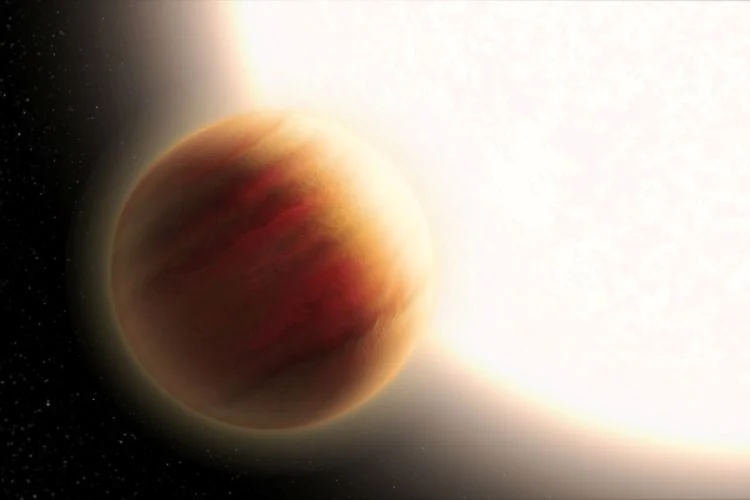
The field of exoplanetary science has been defined by its ability to challenge established norms of celestial mechanics since the first discovery of a planet orbiting a sun-like star in 1995. Among the most perplexing of these discoveries are "hot Jupiters"—gas giants that orbit their host stars at precariously close distances, often completing a full "year" in a matter of days or even hours. While these planets have long provided a laboratory for studying extreme atmospheric conditions and orbital dynamics, a new discovery has introduced a temporal urgency to the field. An international team of researchers has identified a hot Jupiter, designated TOI-1355 b, whose orbital trajectory is shifting so rapidly that it is expected to vanish from Earth’s view entirely by the year 2033. This finding, recently published in the Publications of the Astronomical Society of Japan, suggests that the window for studying certain eccentric exoplanets may be much narrower than previously assumed.
The Discovery and Characterization of TOI-1355 b
Located approximately 805 light-years from Earth, TOI-1355 b is a massive gas giant that pushes the boundaries of planetary classification. With a mass approximately 5.84 times that of Jupiter and a radius 1.42 times larger, it is a "super-Jupiter" of immense proportions. It maintains an incredibly tight orbit around its host star, completing a revolution every 2.17 days.
The planet was initially flagged by NASA’s Transiting Exoplanet Survey Satellite (TESS), a space telescope designed to scan the brightest stars in the sky for periodic dips in light. These dips, known as transits, occur when a planet passes between its host star and the observer. By measuring the depth and duration of these transits, astronomers can calculate a planet’s size, orbital period, and distance from its star. However, TOI-1355 b presented anomalies that necessitated follow-up observations from ground-based facilities, specifically the Okayama Observatory of Kyoto University in Japan.
What makes TOI-1355 b particularly noteworthy is its orbital eccentricity. While Earth maintains a nearly circular orbit with an eccentricity of 0.0167, TOI-1355 b possesses an eccentricity of 0.22. In the scale of orbital mechanics, where 0 represents a perfect circle and 1 represents a parabolic escape trajectory, 0.22 indicates a distinctly oval path. This eccentric orbit suggests a violent or complex gravitational history, likely involving interactions with other massive bodies within its system that "kicked" the planet into its current tight, elongated path.
The Mechanics of a "Vanishing" Planet
The most startling revelation of the study is not the planet’s size or its eccentricity, but its changing orbital tilt, or inclination. In celestial mechanics, the plane of a planet’s orbit is not always static. Due to a phenomenon known as nodal precession—often caused by the gravitational influence of the host star’s equatorial bulge or the presence of an unseen companion planet—the orbital plane can rotate over time.
For an exoplanet to be detected via the transit method, its orbital plane must be aligned almost perfectly with Earth’s line of sight. If the orbit tilts even slightly away from this "edge-on" perspective, the planet will appear to pass above or below the star’s disk rather than across it. According to the research team’s analysis, TOI-1355 b is currently undergoing such a shift. The data suggests that the planet’s orbital inclination is changing at a rate that will cause it to miss the stellar disk entirely by 2033.
This creates a "vanishing" effect. The planet will still exist and continue to orbit its star, but from the perspective of Earth-based telescopes, the transits will cease. This phenomenon turns TOI-1355 b into a "ticking clock" for researchers. Once the transits stop, measuring the planet’s atmospheric composition or refining its radius will become significantly more difficult, if not impossible, with current technology.
Anomalies in the Secondary Eclipse
The research was spearheaded by Dr. Noriharu Watanabe, a project researcher at the University of Tokyo. Dr. Watanabe’s team was initially drawn to TOI-1355 b because of discrepancies in its secondary eclipse data. A secondary eclipse occurs when a planet passes behind its host star. In a perfectly circular orbit, the secondary eclipse occurs exactly half an orbital period after the primary transit.
"When we investigated the change in brightness of TOI-1355 from prior data, we found that the secondary eclipse… occurred faster than the timing assumed for a circular orbit," Dr. Watanabe stated. This timing offset was the "smoking gun" for the planet’s high eccentricity.
Furthermore, Dr. Watanabe noted that while thousands of planets have been found around stars similar to or cooler than our Sun (G-type and M-type stars), surveys around hotter stars (such as F-type stars, which TOI-1355 likely represents) are less advanced. Hotter stars rotate faster and have different magnetic properties, which can influence the orbital evolution of nearby gas giants. The study of TOI-1355 b provides a rare glimpse into how hot Jupiters behave in these more radiation-intensive environments.
Chronology of Observation and the 2033 Deadline
The timeline for TOI-1355 b research is remarkably compressed compared to typical astronomical scales:
- 2018–2021: Initial detection by NASA’s TESS mission during its primary and extended surveys.
- 2022–2023: Ground-based follow-up at Okayama Observatory confirms the mass and eccentric nature of the planet.
- 2024: Publication of the findings detailing the rapid change in orbital inclination.
- 2024–2032: The "Golden Window" for observation. This period is critical for utilizing high-resolution spectrographs and facilities like the James Webb Space Telescope (JWST) to characterize the planet’s atmosphere before the transit signal degrades.
- 2033: Predicted end of observable transits. TOI-1355 b will become a "non-transiting" exoplanet, detectable only through radial velocity (the "wobble" method), which provides mass data but no information on radius or atmosphere.
Scientific Context: The Hot Jupiter Enigma
The existence of hot Jupiters has been a thorn in the side of planetary formation theories for nearly three decades. Standard models of solar system formation suggest that giant planets must form far from their host stars, past the "frost line," where volatile compounds like water and methane can condense into solid ice to build a massive core.
To explain why planets like TOI-1355 b are found so close to their stars, astronomers propose "planetary migration." There are two primary theories for this:
- Disk Migration: The planet moves inward smoothly through the protoplanetary disk of gas and dust shortly after formation.
- High-Eccentricity Migration: The planet is gravitationally disturbed by another planet or a passing star, sending it into a highly elliptical orbit that gradually circularizes and shrinks due to tidal forces from the host star.
The high eccentricity and shifting tilt of TOI-1355 b strongly support the high-eccentricity migration theory. It suggests a "tumultuous history," as described by the researchers, indicating that the system may have once hosted other massive bodies that were ejected or relocated during a period of dynamical instability.
Broader Implications for Exoplanetary Surveys
The discovery of TOI-1355 b serves as a warning for the astronomical community: the population of transiting exoplanets is not static. If orbital precession is common among eccentric hot Jupiters, then many planets currently in our catalogs may eventually "disappear," while others that do not currently transit may "appear" in the future as their orbits tilt into our line of sight.
This dynamic nature of exoplanetary systems necessitates long-term monitoring. It also highlights the importance of missions like TESS and the upcoming PLATO (Planetary Transits and Oscillations of stars) mission by the European Space Agency, which aim to observe the same patches of sky over multiple years to detect such changes.
Analysis of Potential Insights
In the remaining seven years of observability, TOI-1355 b offers a unique opportunity to study "tidal inflation." Many hot Jupiters are larger than they should be based on their mass, likely because the intense radiation and tidal friction from their host stars "puff up" their atmospheres. Because TOI-1355 b is on an eccentric orbit, the tidal forces it experiences vary wildly throughout its 2.17-day year. Observing how the planet’s atmosphere reacts to these rapid changes in heat and gravity could provide definitive data on the internal structure of gas giants.
Furthermore, the disappearance of TOI-1355 b provides a rare chance to calculate the "oblateness" or "squashedness" of the host star. The rate at which the planet’s orbit precesses is directly related to the distribution of mass within the star. By precisely timing the vanishing of the transit, scientists can effectively "weigh" the star’s equator.
Conclusion: A Ticking Clock in the Cosmos
The case of TOI-1355 b underscores the fact that the universe is far from a static clockwork mechanism. It is a place of constant motion and evolution, where even giant planets can drift out of view within a human lifetime. The international team led by Dr. Watanabe has provided the scientific community with a rare "heads-up," allowing for a concerted effort to document this world before it slips into the shadows.
As 2033 approaches, astronomers will likely prioritize TOI-1355 b for observation with the world’s most powerful instruments. The data gathered in these final years will not only tell the story of one vanishing giant but will also refine our understanding of how planetary systems across the galaxy form, migrate, and eventually settle into their final, often eccentric, configurations. For now, the race is on to capture the secrets of TOI-1355 b before its shadow leaves the face of its star for the last time.