Sisilia Frederika
The celestial event known as V445 Puppis has remained one of the most enduring enigmas in modern astrophysics since its sudden eruption in late 2000. For nearly a quarter of a century, this stellar explosion presented a "cold case" for the scientific community, as the very cataclysm that brought it to prominence also shrouded it in a dense, impenetrable veil of cosmic debris. Unlike the vast majority of novae observed in our galaxy, which are fueled by the runaway thermonuclear combustion of hydrogen, V445 Puppis exhibited a chemical signature entirely devoid of that element. This anomalous characteristic marked it as the first and only confirmed helium nova within the Milky Way, a discovery that challenged existing models of stellar evolution and binary system dynamics. Recent breakthroughs led by researchers at the University of Warwick have finally pierced through the dust, revealing the intricate machinery of the system and providing critical insights into the potential precursors of Type Ia supernovae—the "standard candles" used to measure the expansion of the universe.
The Mechanics of a Stellar Detonation: Hydrogen vs. Helium
To understand the significance of V445 Puppis, one must first understand the standard mechanics of a classical nova. In a typical binary system, a white dwarf—the ultra-dense, Earth-sized remnant of a Sun-like star—exists in a tight orbital dance with a companion star. Through gravitational pull, the white dwarf siphons material, primarily hydrogen, from its companion’s outer layers. This "stolen" gas accumulates on the surface of the white dwarf in a layer known as an accretion disk. As the pressure and temperature at the base of this hydrogen heap reach critical levels, a runaway thermonuclear reaction occurs. This results in a massive explosion that increases the system’s brightness by thousands of times, yet leaves the white dwarf intact to begin the cycle anew.
V445 Puppis, however, deviated fundamentally from this established pattern. When it erupted in late 2000, spectroscopic analysis revealed a startling lack of hydrogen. Instead, the explosion was fueled by helium. This indicated that the material being siphoned by the white dwarf was not the standard hydrogen-rich gas of a main-sequence star, but rather the helium-rich remains of a star that had already lost its outer hydrogen envelope. Such systems are theorized to exist but are vanishingly rare, representing a fleeting stage in the complex evolution of binary star systems.
A Quarter-Century of Obscuration: The Dust Problem
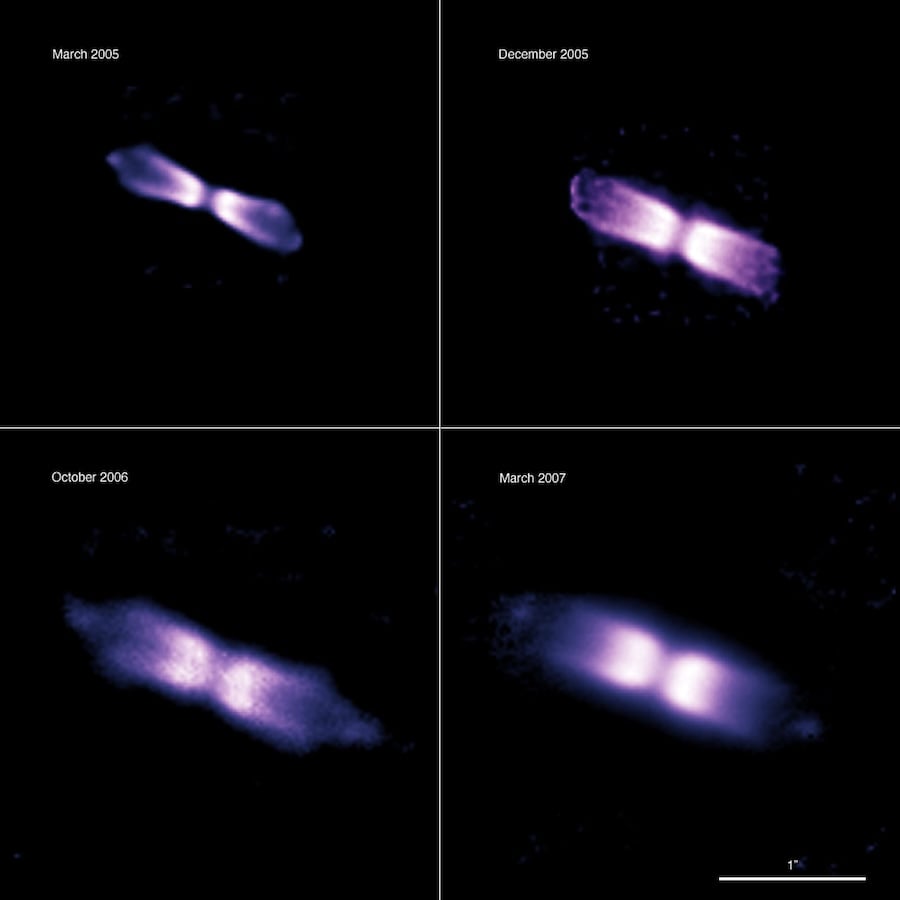
The primary obstacle in studying V445 Puppis was the immediate aftermath of its eruption. The explosion launched a bipolar outflow—two massive jets of matter traveling in opposite directions—that stretched across more than a trillion kilometers of space. As this material cooled, it condensed into a thick, opaque disk of carbon-rich dust. This "smoke screen" effectively hid the central binary system from view for over two decades.
While astronomers could track the expansion of the outer debris using radio and infrared imaging, the "engine" of the system remained invisible. This created a significant gap in data; without seeing the stars themselves, researchers could only speculate about the orbital period, the mass of the components, and the rate at which material was being transferred between them. The clearing of this dust over the last few years has finally provided a window into the heart of the system, allowing for a comprehensive multi-instrument investigation.
The Breakthrough: A Multi-Observatory Investigation
A research team led by John Mills of the University of Warwick recently synthesized two decades of data to reconstruct the V445 Puppis system. This Herculean effort involved combining high-resolution infrared data from the European Southern Observatory’s Very Large Telescope (VLT) in Chile, optical imaging from the Hubble Space Telescope, and twenty years of spectroscopic observations from the Southern African Large Telescope (SALT). To finalize the picture, the team utilized high-cadence photometry from NASA’s Transiting Exoplanet Survey Satellite (TESS).
The results of this study have redefined our understanding of the system. The central engine of V445 Puppis is a binary pair consisting of a white dwarf and a helium star companion. The study revealed that the two objects circle each other every 3.7 days. This orbital period is significantly longer than previous estimates, which had suggested a much tighter, faster orbit. The discovery of the 3.7-day period is crucial because it allows astronomers to calculate the masses and separation of the stars more accurately, providing a clearer picture of the system’s long-term stability and eventual fate.
The Anatomy of a Rare Binary: The Helium Donor
The companion star in the V445 Puppis system is a rarity in its own right. Known as a helium star, it is the core of a formerly larger star that has been stripped of its hydrogen envelope. In this specific case, it is highly probable that the white dwarf companion is the culprit, having gradually robbed the other star of its outer layers over millions of years.
Astronomers estimate that out of the hundreds of billions of stars in the Milky Way, only a few thousand such systems exist. The rarity of these objects makes V445 Puppis a vital "laboratory" for studying extreme stellar astrophysics. Observations confirm that despite the massive eruption in 2000, the white dwarf has already resumed its "theft" of material, indicating that the system is currently rebuilding its helium layer for a future detonation.
High-Speed Clumps and Oxygen Anomalies
One of the most perplexing findings in Mills’ research involves the presence of embedded clumps of gas within the bipolar outflow. These clumps are moving at staggering velocities of up to 12 million kilometers per hour—roughly 1% of the speed of light. Initial analysis suggests these clumps may be rich in oxygen, a byproduct of advanced nuclear burning.
Mills suspects that these clumps were not part of the initial eruption in 2000 but were launched shortly thereafter in a series of secondary events. The physics behind such high-speed, localized ejections remains unclear, as nothing quite like them has been observed in any other nova event. These clumps provide a unique challenge for hydrodynamic modeling, suggesting that the interior of a helium nova is far more turbulent and complex than previously assumed.
Implications for the Cosmic Yardstick: Type Ia Supernovae
The scientific community’s intense interest in V445 Puppis extends far beyond its status as a celestial oddity. The system is a prime candidate for a progenitor of a Type Ia supernova. These supernovae occur when a white dwarf in a binary system accumulates so much mass that it exceeds the Chandrasekhar limit—approximately 1.4 times the mass of our Sun. At this point, the white dwarf can no longer support itself against gravity, and it undergoes a catastrophic, total thermonulcear explosion that destroys the star completely.
Type Ia supernovae are of paramount importance to cosmology because they have a remarkably consistent peak brightness. This allows astronomers to use them as "standard candles" to measure distances across the universe. It was through the study of these supernovae that researchers discovered in the late 1990s that the expansion of the universe is not slowing down, but is actually accelerating—a discovery that led to the concept of dark energy.
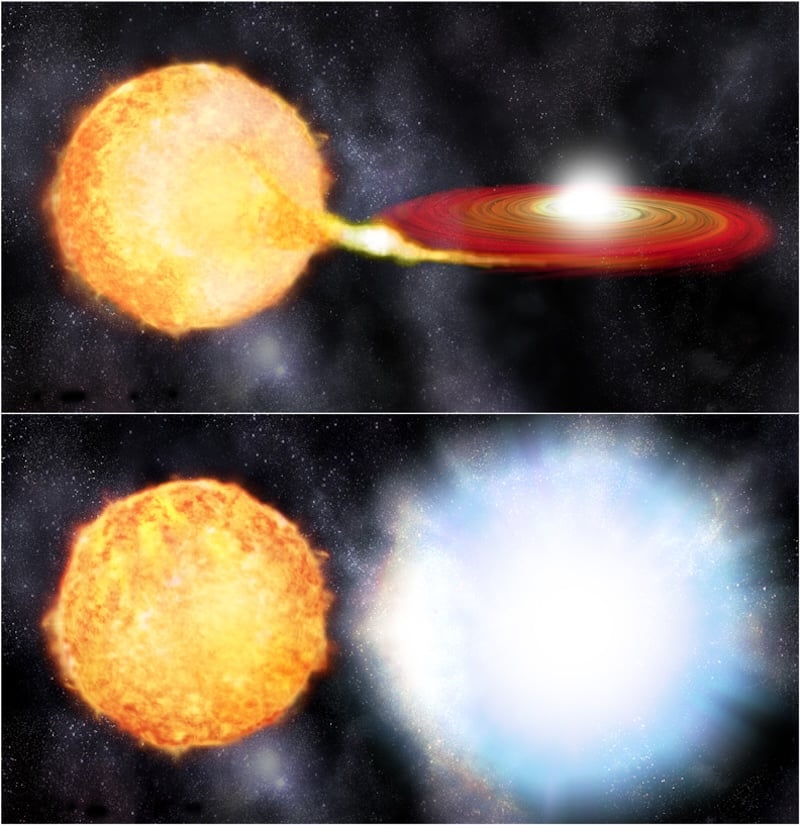
However, the exact nature of the systems that lead to Type Ia explosions remains a subject of intense debate. One leading theory suggests that the gradual accumulation of helium, rather than hydrogen, may be a more efficient way for a white dwarf to reach the critical mass limit without losing too much material during intermediate nova eruptions. V445 Puppis provides the first direct evidence of a system following this specific evolutionary path.
Chronology of Discovery and Observation
The timeline of V445 Puppis highlights the patience required in modern observational astronomy:
- November 2000: The nova is first detected, showing an unusual lack of hydrogen in its spectrum.
- 2001–2005: A massive dust shell forms, obscuring the central stars. Bipolar jets are identified via radio observations.
- 2005–2015: The system remains largely hidden in the optical spectrum. Long-term monitoring continues via SALT and infrared telescopes.
- 2016–2022: The dust begins to thin sufficiently for deeper optical and infrared probes to reach the central binary.
- 2023–2024: John Mills and his team publish the definitive analysis of the 3.7-day orbital period and the nature of the helium donor star.
Expert Analysis and Future Outlook
The findings from the University of Warwick represent a significant milestone in stellar archaeology. By piecing together the "crime scene" of V445 Puppis, astronomers have confirmed that helium novae are not just theoretical constructs but active participants in the galaxy’s chemical and structural evolution.
The ongoing observation of V445 Puppis will be critical in the coming years. As the debris continues to clear, telescopes like the James Webb Space Telescope (JWST) could potentially provide even more detailed chemical maps of the outflow, specifically investigating the oxygen-rich clumps. If V445 Puppis continues to gain mass at its current rate, it may eventually reach the Chandrasekhar limit, providing a front-row seat to the birth of a Type Ia supernova.
For now, V445 Puppis stands as a singular monument to the diversity of stellar deaths and rebirths. It serves as a reminder that the "standard" models of the universe often have rare, high-energy exceptions that hold the keys to understanding the cosmos on its largest scales. Whether this system ends in a brilliant supernova or continues its cycle of helium eruptions, it has already secured its place as one of the most important stellar laboratories in the Milky Way.