Sisilia Frederika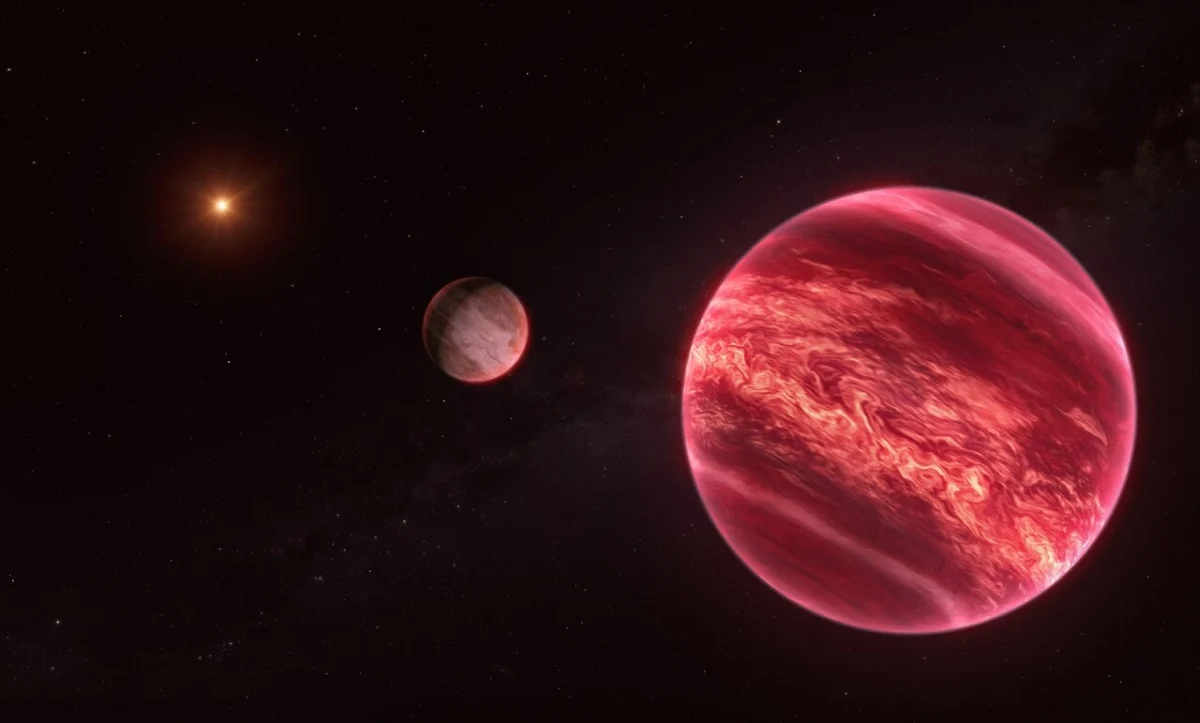
The discovery of a Jupiter-sized celestial body orbiting a brown dwarf, which in turn orbits a distant red dwarf star, has fundamentally challenged established astronomical taxonomies and the conventional understanding of how solar systems are structured. This finding, centered on the star system CD-35 2722, represents the first confirmed "exo-satellite" of planetary mass orbiting a substellar object. Located approximately 70 light-years from Earth, the system has become a focal point for researchers seeking to define the blurry boundaries between planets, moons, and stars. The study, recently published in the journal Nature, details a complex hierarchical architecture that defies the simple "star-planet-moon" triad that has dominated astronomical education for centuries.
The Architecture of the CD-35 2722 System
At the heart of this discovery is CD-35 2722, an M-type red dwarf. M-type stars are the most common in the Milky Way, characterized by their small size, low surface temperature, and extreme longevity. Despite their ubiquity, their low luminosity often makes their orbiting companions difficult to detect. However, spectral observations of this specific red dwarf revealed a periodic "wobble" in its motion, a gravitational signature indicating the presence of a massive companion.
This companion, designated CD-35 2722b, was initially identified as a brown dwarf. With an estimated mass between 29 and 38 times that of Jupiter, CD-35 2722b occupies a unique niche in the cosmos. It is far more massive than any planet in our solar system but lacks the necessary mass—roughly 75 to 90 Jupiter masses—to initiate the sustained hydrogen fusion that defines a true star. Instead, brown dwarfs like CD-35 2722b are capable of fusing deuterium (a heavy isotope of hydrogen) during their early stages, a process that places them in a "substellar" category often referred to as "failed stars."
The breakthrough occurred when researchers utilized the European Southern Observatory’s (ESO) Very Large Telescope (VLT) to perform direct imaging and high-resolution spectral analysis of the brown dwarf itself. These observations detected a secondary, smaller wobble within the motion of CD-35 2722b. This secondary gravitational tug was traced to a planetary-mass object, roughly equivalent to the mass of Jupiter, orbiting the brown dwarf. This object is the first of its kind to be confirmed: a planetary-mass exo-satellite.
Taxonomic Ambiguity and the Evolution of Planetary Definitions
The existence of a Jupiter-sized object orbiting a brown dwarf brings the ongoing debate regarding the definition of a "planet" to a new level of complexity. Since the International Astronomical Union (IAU) redefined the term "planet" in 2006, the scientific community has remained divided. The IAU’s current criteria require a body to orbit the Sun, be nearly round in shape, and have "cleared its orbital neighborhood" of other debris. This definition famously led to the demotion of Pluto to "dwarf planet" status because it shares its orbital path with other Kuiper Belt objects.
The CD-35 2722 system exposes the limitations of these definitions when applied to systems outside our own. If CD-35 2722b is a brown dwarf (a substellar object), is the Jupiter-sized body orbiting it a "moon" or a "planet"? In our solar system, moons are defined by their orbit around a planet. However, if the primary body is not a star, but also not quite a planet, the nomenclature becomes murky.
The debate is further complicated by the scale of these objects. Jupiter, the largest planet in our solar system, is significantly smaller than the "moon" in the CD-35 2722 system. Conversely, our own Moon is larger than the dwarf planet Pluto. If mass and size are the primary metrics, the Jupiter-sized satellite of CD-35 2722b would be a planet; however, based on its orbital relationship, it functions as a moon. This has led some astronomers to propose the term "exo-satellite" or "substellar companion" to avoid the baggage associated with the terms "moon" and "planet."
Chronology of the Discovery and Methodology
The identification of this complex system was the result of a multi-year observational campaign involving several of the world’s most advanced astronomical instruments.
- Initial Survey (2018–2021): Early radial velocity surveys of nearby M-dwarf stars identified CD-35 2722 as a candidate for hosting a massive companion. The star’s periodic spectral shifts suggested a body with several dozen times the mass of Jupiter.
- Confirmation of the Brown Dwarf (2022): Using high-contrast imaging, astronomers confirmed the presence of CD-35 2722b. Its distance from the host star allowed for it to be resolved as a distinct point of light, making it a prime candidate for further study.
- Spectral Analysis of the Companion (2024–2025): Researchers focused the VLT’s spectrographs on the brown dwarf itself. By isolating the light from CD-35 2722b, they were able to measure its radial velocity with unprecedented precision.
- Detection of the Exo-satellite (2026): The data revealed a regular oscillation in the brown dwarf’s velocity that could only be explained by the presence of a Jupiter-mass object. This finding was cross-referenced with atmospheric models to ensure the signal was not caused by magnetic activity or "spots" on the brown dwarf’s surface.
The team, led by K. Hoy and A. Zurlo, utilized the SPHERE (Spectro-Polarimetric High-contrast Exoplanet REsearch) instrument at the VLT. This technology is designed to suppress the light of a host star to reveal the faint signatures of nearby companions, a task that is exceptionally difficult when the "host" is a dim brown dwarf and the companion is a planet.
Supporting Data and Physical Characteristics
The physical characteristics of the CD-35 2722 system provide a glimpse into a world that is vastly different from our own. Brown dwarfs occupy a wide range of temperatures. The largest and youngest can have surface temperatures reaching 2,000 Kelvin (K), glowing with a dull red or magenta light. The smallest and oldest may be as cool as a household oven. CD-35 2722b is categorized as a mid-sized brown dwarf, meaning it likely retains significant internal heat from its gravitational contraction and early deuterium fusion.
The Jupiter-sized exo-satellite orbits this brown dwarf at a distance that suggests a dynamic gravitational relationship. Because brown dwarfs do not emit as much radiation as stars, the "habitable zone"—the region where liquid water could theoretically exist—is much closer to the brown dwarf than it would be for a star like our Sun. However, the presence of a massive satellite so close to a brown dwarf introduces the factor of tidal heating. Just as Jupiter’s gravity causes volcanic activity on its moon Io, the brown dwarf CD-35 2722b likely exerts massive tidal forces on its satellite, potentially keeping its interior molten even if it receives little light from the distant red dwarf star.
Scientific Reactions and Implications for Astrobiology
The announcement has sparked significant discussion within the astronomical community. Dr. Sarah Rugheimer, an astrophysicist not involved in the study, noted that "this discovery forces us to reconsider where we look for life. We have traditionally looked for Earth-like planets around Sun-like stars. But if brown dwarfs can host Jupiter-sized satellites, and those satellites can host their own moons or have habitable surfaces due to tidal heating, the number of ‘habitable’ environments in the galaxy could be orders of magnitude higher than we thought."
Other researchers have highlighted the implications for planetary formation theories. Traditional models suggest that planets form from a protoplanetary disk of gas and dust surrounding a young star. The existence of a "mini-solar system" (a brown dwarf with its own satellite) orbiting a larger star suggests a hierarchical formation process where the disk around the star fragmented to form the brown dwarf, which then had its own sub-disk that formed the exo-satellite. This "cascading" formation model challenges the idea that planets and moons are distinct categories of objects formed by different processes.
The Future of Exo-satellite Research
The discovery of the CD-35 2722 exo-satellite is expected to usher in a new era of "exomoon" hunting. While thousands of exoplanets have been confirmed, detecting moons orbiting those planets has proven extremely difficult due to their small size and the overwhelming glare of their host stars. By looking for satellites around brown dwarfs—which are dimmer and less massive than stars—astronomers may find it easier to detect and characterize these elusive worlds.
Upcoming missions, including the Extremely Large Telescope (ELT) currently under construction in Chile, will have the sensitivity to analyze the atmospheres of these exo-satellites. If the Jupiter-sized body in the CD-35 2722 system has an atmosphere, researchers could look for chemical biosignatures such as oxygen, methane, or water vapor.
Furthermore, the James Webb Space Telescope (JWST) is expected to be tasked with observing this system in the infrared spectrum. This will allow scientists to determine the exact temperature of the exo-satellite and the brown dwarf, providing more data on whether the satellite is a frigid gas giant or a world warmed by the internal heat of its substellar parent.
As the study of the CD-35 2722 system continues, it serves as a reminder that the universe rarely adheres to the neat categories humans create for it. Whether we call it a moon, a planet, or an exo-satellite, the Jupiter-sized world orbiting CD-35 2722b is a testament to the diversity of the cosmos. The only certainty, as noted in the Nature publication, is that while this is the first such world to be confirmed, the advancements in observational technology ensure it will certainly not be the last. The "clear definitions" of the past are giving way to a more nuanced, complex, and ultimately more accurate map of the stars.