Sisilia Frederika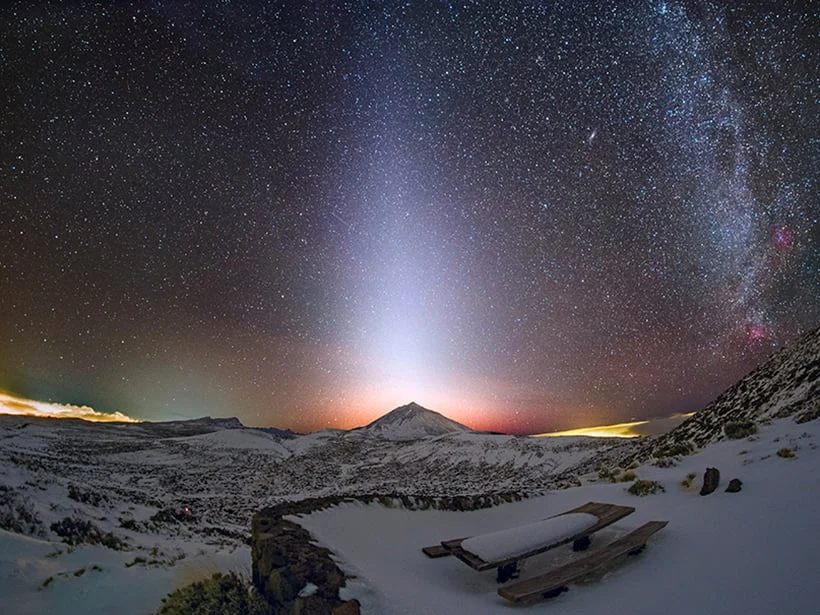
The pursuit of identifying life beyond our solar system has long focused on the "Goldilocks zone," the orbital region where liquid water can persist on a planetary surface. However, a significant and often overlooked obstacle resides within these very regions: a diffuse cloud of cosmic debris known as exozodiacal dust. A new study led by Miles H. Currie and published in the arXiv preprint repository, titled "The exozodi spectral effect: Residual habitable zone dust may bias exoEarth characterization," warns that this dust may severely compromise our ability to detect biosignatures in the atmospheres of distant, Earth-like worlds. By scattering and absorbing starlight, this "exozodi" creates a veil that can weaken critical spectral signals by as much as 50 percent, potentially leading to false negatives in the search for extraterrestrial life.
The Phenomenon of the False Dawn and the Zodiacal Cloud
To understand the challenge facing astronomers, one must first look at our own celestial backyard. For centuries, observers in dark-sky locations have noted a phenomenon known as the "false dawn." Appearing as a faint, triangular column of light rising from the horizon before sunrise or lingering after sunset, this glow is not atmospheric in origin. Instead, it is the result of sunlight reflecting off a vast disk of microscopic dust particles—each ranging from 10 to 100 micrometers in size—spread throughout the inner solar system.
This zodiacal cloud is concentrated along the ecliptic plane, the flat path where the planets orbit the Sun. It is a dynamic structure, constantly replenished by the disintegration of comets as they approach the Sun and by occasional collisions between asteroids in the belt between Mars and Jupiter. While the zodiacal light is a beautiful curiosity for stargazers on Earth, its presence around other stars—referred to as exozodiacal dust—poses a formidable technical hurdle for the next generation of space telescopes.
The Currie Study: Quantifying the Masking Effect
The research conducted by Currie and his colleagues utilizes sophisticated simulations to model how an "exo-Earth"—a planet with an atmosphere similar to our own—would appear to an observer if it were embedded in a system with varying levels of exozodiacal dust. The primary method for studying these planets is transmission spectroscopy. When a planet transits in front of its host star, a portion of the starlight passes through the planet’s atmosphere. Different molecules, such as oxygen, methane, carbon dioxide, and water vapor, absorb specific wavelengths of light, leaving a "fingerprint" or absorption spectrum that reveals the atmosphere’s chemical composition.
The study’s findings indicate that exozodiacal dust does not merely add background noise; it actively distorts the spectral data. The dust particles scatter the incoming starlight, a process that is particularly aggressive at longer wavelengths. This scattering effectively "fills in" the absorption lines that astronomers are looking for, making the atmosphere appear thinner or less chemically complex than it actually is. In the simulated models, the presence of dust at levels comparable to our own solar system reduced the strength of biosignature signals by up to 50 percent. This attenuation creates a significant bias, as it could lead researchers to underestimate the concentration of life-sustaining gases or miss them entirely.
A Chronology of Exoplanetary Detection and Atmospheric Study
The evolution of exoplanet science has moved rapidly from discovery to characterization. The following timeline highlights the progression toward the current focus on exozodiacal interference:
- 1995: The discovery of 51 Pegasi b, the first exoplanet found orbiting a sun-like star, proved that other planetary systems exist.
- 2009–2018: The Kepler Space Telescope mission identifies thousands of exoplanets, revealing that small, rocky worlds are common in the galaxy.
- 2014: The Large Binocular Telescope Interferometer (LBTI) begins the HOSTS (Hunt for Observable Signatures of Terrestrial Systems) survey to measure the brightness of exozodiacal dust around nearby stars.
- 2021–Present: The James Webb Space Telescope (JWST) begins providing the first detailed atmospheric spectra of gas giants and some smaller planets, though it struggles with the contrast required for Earth-sized worlds in the habitable zone.
- 2026 (Current Study): The Currie et al. paper highlights the "exozodi spectral effect" as a primary concern for the design of future "Direct Imaging" missions.
- 2030s–2040s: NASA’s planned Habitable Worlds Observatory (HWO) aims to directly image 25 Earth-like planets, a mission that will be directly impacted by the findings of this study.
Comparative Data: Why Other Systems Are "Dustier"
One of the most concerning aspects of the Currie study is the comparison between our solar system and others. Our solar system is relatively "clean" in terms of dust density. However, surveys of nearby sun-like stars suggest that many systems possess exozodiacal clouds that are significantly more substantial.
Data from the HOSTS survey and other infrared observations indicate that the median level of exozodiacal dust around nearby stars is approximately three times higher than the level found in our solar system. In some younger or more gravitationally turbulent systems, the dust density can be ten to one hundred times higher. For these systems, the masking effect is not just a 50 percent reduction in signal; it could potentially render the atmosphere of a rocky planet completely invisible to current spectroscopic techniques. The study suggests that for every "exo-Earth" candidate, astronomers must first perform a "dust audit" of the system to determine the baseline interference before they can trust the atmospheric readings.
Technical Analysis of Light Scattering
The bias introduced by exozodiacal dust is rooted in the physics of Mie scattering. Unlike Rayleigh scattering, which explains why the Earth’s sky is blue by scattering shorter wavelengths, Mie scattering occurs when the particles are roughly the same size as the wavelength of the light. Because exozodiacal dust particles are relatively large (micrometer-scale), they scatter light across a broad range of the infrared and visible spectrum.
The Currie study emphasizes that this scattering is wavelength-dependent. At longer wavelengths—precisely where many important biosignatures like methane and nitrous oxide are located—the dust’s scattering efficiency increases. This creates a "slanted" bias in the data. If an astronomer does not account for the exozodi, they might interpret the dampened signal as a lack of a certain gas, rather than an interference pattern caused by the surrounding dust cloud.
Implications for the Habitable Worlds Observatory
The results of this study have immediate implications for the Habitable Worlds Observatory (HWO), the flagship mission recommended by the 2020 Decadal Survey on Astronomy and Astrophysics. The HWO is being designed specifically to find and characterize at least 25 habitable-zone planets around sun-like stars.
To succeed, the HWO will use a coronagraph—a device that blocks the direct light of a star to see the faint planets orbiting it. However, a coronagraph cannot easily block the light from an exozodiacal disk because the dust is spread throughout the system, often overlapping with the planet’s position from our perspective. Scientists involved in mission planning have noted that if the "exozodi" is too bright, the exposure times required to "see through" the dust to the planet’s atmosphere could increase from days to weeks or even months per target. This would drastically reduce the number of planets the mission could study over its lifetime.
Mitigation Strategies and Future Outlook
Despite the sobering findings, the study by Currie et al. does not conclude that the search for life is futile. Instead, it provides a roadmap for more rigorous data analysis. Several mitigation strategies are currently being proposed:
- Multi-Wavelength Modeling: By observing a system at multiple wavelengths, astronomers can create a profile of the dust’s scattering properties and subtract that "noise" from the planetary spectrum.
- High-Resolution Spectroscopy: Using instruments with higher spectral resolution can help distinguish between the broad, diffuse scattering of dust and the sharp, narrow absorption lines of atmospheric gases.
- Longer Integration Times: Simply collecting more light over longer periods can improve the signal-to-noise ratio, though this requires more "telescope time," which is a highly contested resource.
- Nulling Interferometry: This technique involves combining light from multiple telescopes to cancel out the light from the star and its surrounding dust disk, leaving only the light from the planet.
Conclusion: A More Nuanced Search for Life
The discovery of the "exozodi spectral effect" marks a transition in exoplanetary science from a period of discovery to a period of precision. It serves as a reminder that the space between the stars is not truly empty, and that the environments in which planets reside are as important as the planets themselves.
As the astronomical community prepares for the next decade of exploration, the focus must shift toward understanding the complex interplay between starlight, dust, and planetary atmospheres. While the "false dawn" of exozodiacal dust may cloud our initial view, the development of more sophisticated models and observation techniques ensures that the search for a second Earth remains a viable, albeit more challenging, scientific endeavor. The work of Currie and his team highlights that in the quest to find life among the stars, we must first learn to see through the dust of the cosmos.